You can absolutely make a small patio feel comfortable, stylish, and functional, it just takes a little more intentional planning than a large space does. If you’re also wondering how to make an apartment patio look nice, start with layout and visual tricks like lighting, mirrors, and layered zones. The key moves are: define what you actually want the patio to do, pick furniture scaled to the space, use visual tricks to push the walls out, and add shade or privacy so the space works year-round. Whether you're working with a tiny 6x8 apartment balcony, a narrow front stoop, or a cramped backyard slab, the same principles apply.
How to Decorate Small Patios: Layout, Furniture, and Style

Felix Brennan
3 May 2026
Start by deciding what your small patio actually needs to do
Before you buy a single chair or string a single light, spend five minutes asking yourself one honest question: what do I actually want to do out here? This sounds obvious, but it's where most small patio decorating goes sideways. People buy a four-person dining set because it looks nice online, then realize there's no room to walk to the door. Or they load up on plants and end up with a beautiful jungle they can't sit in.
Pick one primary function and design around it. The most common small patio goals are dining for two to four people, a lounging and relaxation zone, a container garden or plant display, or a combination of two of those, but kept simple. Once you know your primary purpose, every furniture and decor decision has a filter: does this serve that goal, or does it eat into my limited square footage for no good reason?
Also note your real constraints before you measure anything. Is there an outward-swinging door that steals two feet of usable space? An awkward corner that collects clutter? A view you want to block (a neighbor's fence, a HVAC unit)? A side that gets brutal afternoon sun? These constraints aren't problems to wish away, they're design parameters that shape your whole layout.
Layout first: how to actually arrange a tiny patio
Layout is everything on a small patio. Get it wrong and even beautiful furniture will feel cramped and frustrating. Get it right and even budget pieces will feel intentional and comfortable.
The 30-inch walkway rule
The single most important rule for small patio layout is this: maintain at least 30 inches of clear walking path, especially from the door to your seating area. This is the minimum that lets a person move comfortably without turning sideways. In higher-traffic areas, say, a path that guests use frequently, aim for 36 to 40 inches.
ADA’s 1991 Standards note that while people using walking aids can maneuver through 32-inch clear openings, they generally need 36-inch-wide passageways and walks for more comfortable gaits 36 to 40 inches. In accessibility guidance comparisons, the U.
S. Access Board notes that a minimum clear width of 36 inches applies to certain accessible passageway and turn scenarios, such as showing a 90-degree turn between 36-inch passages Chapter 4.
For lower-traffic corners where you're just squeezing past to water a plant, 24 inches can work. Don't let furniture creep into that walkway. If it does, the whole space feels like an obstacle course.
The corner trick for dining areas
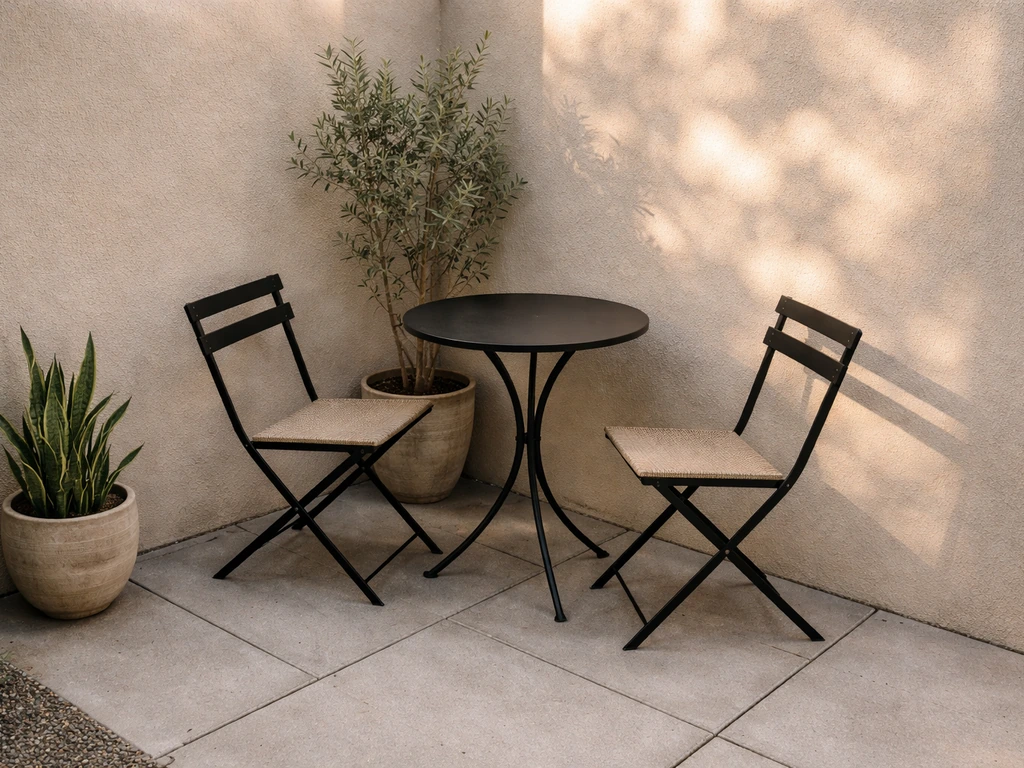
If you want outdoor dining on a small patio, a round table is your best friend. A round table can fit a freestanding dining setup in roughly an 8x8 foot footprint with about 3 feet of clearance around it for pulling chairs in and out. But here's the move that saves the most space: push that round table into a 90-degree corner with two sides against walls.
That single layout change can cut the required footprint by about 25 percent, shrinking your dining area to roughly 6x9 feet instead of 8x8. On a tiny patio, that difference is huge. Add a built-in bench or corner seating along those two walls and you've eliminated the need for chairs on that side entirely, which saves even more room.
Zone your space, even if it's tiny
Even on a very small patio, zoning helps the space feel intentional rather than random. A simple outdoor rug under your seating area defines that zone visually. A small side table with a plant next to it signals a separate "reading corner." You don't need physical dividers, visual cues do the work. On patios under 100 square feet, stick to one primary zone and one small secondary one at most. Trying to squeeze in three distinct areas just creates chaos.
Furniture, decor, and storage that don't swallow the space
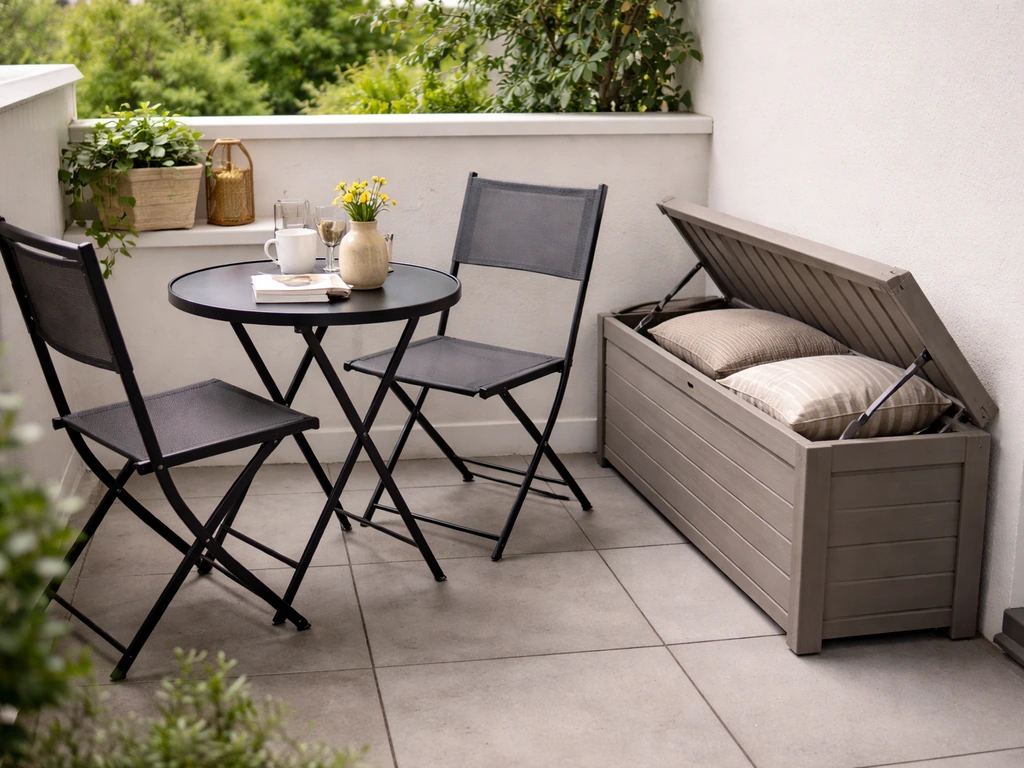
Scale is the biggest mistake people make with small patio furniture. A loveseat that looks normal-sized in a store can dominate a small patio completely. Here's what actually works.
Furniture choices that earn their footprint
- Bistro sets (a small round table with two chairs) are the gold standard for tiny patios — they seat two comfortably and fold away when not in use
- Stackable chairs eliminate the storage problem entirely; stack them against a wall or in a corner when guests leave
- Folding furniture (folding chairs, folding side tables) gives you flexibility — set up for a dinner party, fold away for morning coffee
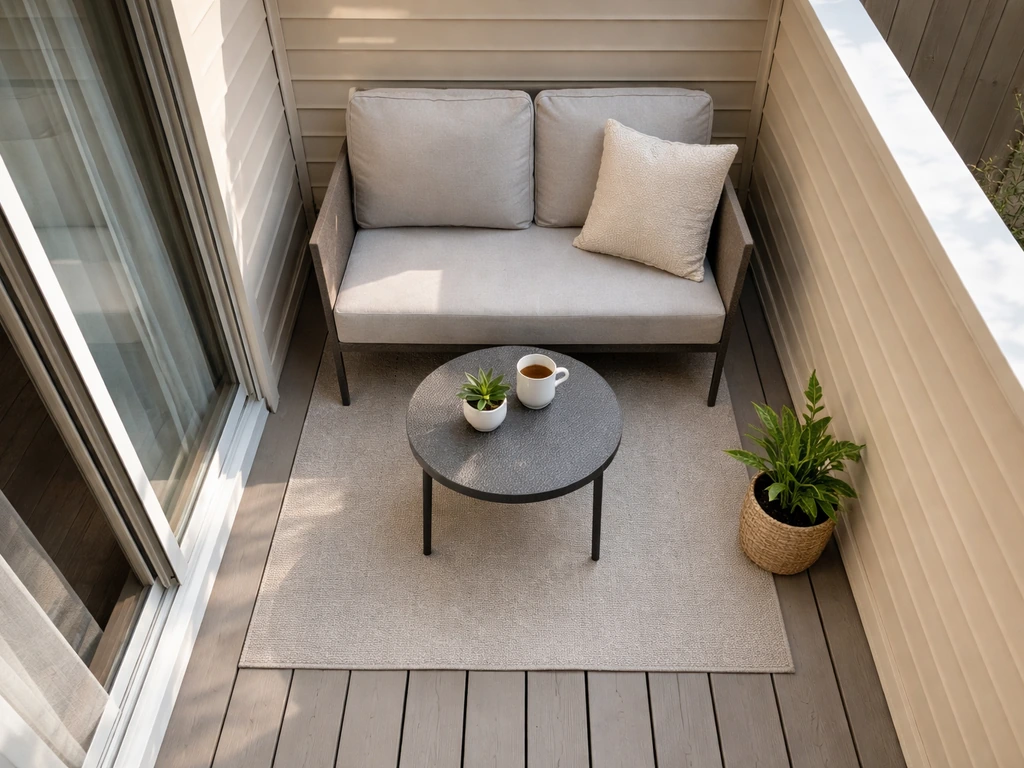
- Loveseat-sized outdoor sofas instead of full three-seaters; a 48-inch loveseat takes dramatically less space than a 72-inch sofa
- Ottomans that double as storage — lift the lid and you have a waterproof bin for cushions, candles, and small tools
- Slim console tables or narrow bar-height tables against a wall serve as prep space, drink ledge, and plant display without projecting far into the space
Vertical storage and display
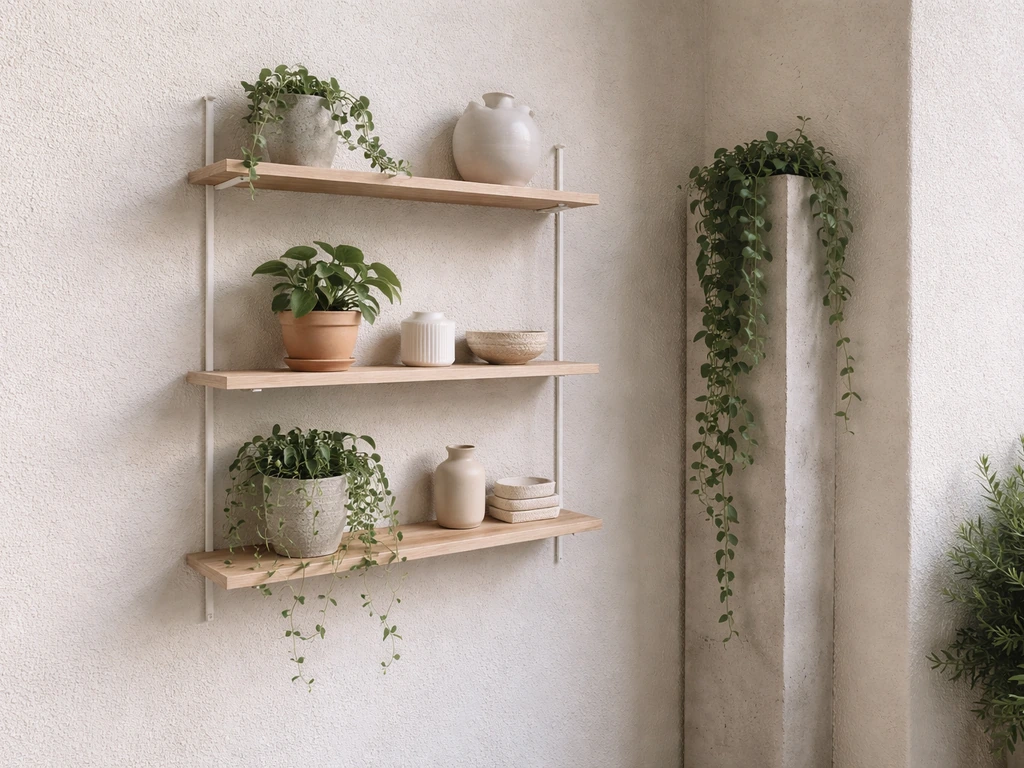
On a small patio, the floor is precious. Move storage and display upward. Wall-mounted shelves hold plants, candles, and small decor without touching the floor. A tall, narrow plant stand brings greenery to eye level without occupying much ground space. Hanging planters from a pergola, fence, or wall bracket keep plants where you can enjoy them without tripping over pots. If you have a privacy fence or wall, use it, mount a small shelf, a hooks rack for tools and lights, or even a wall-mounted folding table that flips up when you need it and folds flat when you don't.
What to skip
- Oversized sectional sofas — even "small" sectionals are usually too big for patios under 150 square feet
- Multiple large planters on the floor competing with furniture legs
- Fire pit tables as primary furniture on very small patios — they require significant clearance on all sides for safety
- Decorative items that serve no function, like large ceramic statues or multiple side tables
- Too many rugs or layered textiles that make the space feel visually heavy
Color, lighting, and visual tricks to make a small patio feel bigger
This is where decoration really earns its keep. The right colors and lighting can make a 6x10 patio feel open and airy instead of cramped. These tricks work on apartment patios, front patios, and small backyard slabs equally well.
Color strategy
Light, cool colors (whites, soft grays, pale blues, sage greens) make surfaces recede visually and expand the perceived space. Use them on walls, fences, furniture, and cushions. One or two pops of a warm accent color (terracotta, mustard, deep green) keep the space from feeling sterile without closing it in. If your patio is enclosed or has a fence, painting that fence or wall a light color, even a simple white or light gray, can dramatically open the space up. Avoid dark, saturated colors on large surfaces like walls or floors unless the patio is very long and narrow (in that case, a dark back wall can actually make the space feel less tunnel-like).
Mirrors and reflective surfaces
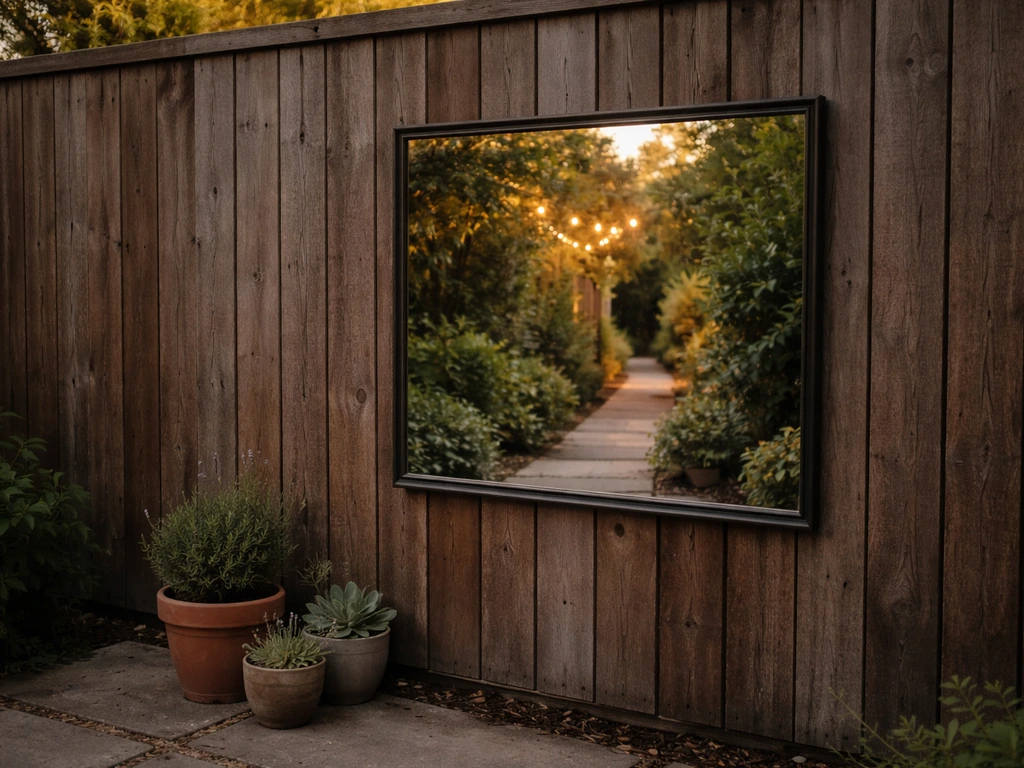
An outdoor-rated mirror mounted on a fence or wall is one of the most effective small-space tricks there is. It literally doubles the perceived depth of the space and bounces light around. Use a mirror with a weather-resistant frame, teak, aluminum, or sealed iron work well, and position it to reflect greenery or sky rather than a boring wall. Metallic planters, polished side table tops, and glass-topped tables all do a lighter version of the same thing.
Lighting that layers
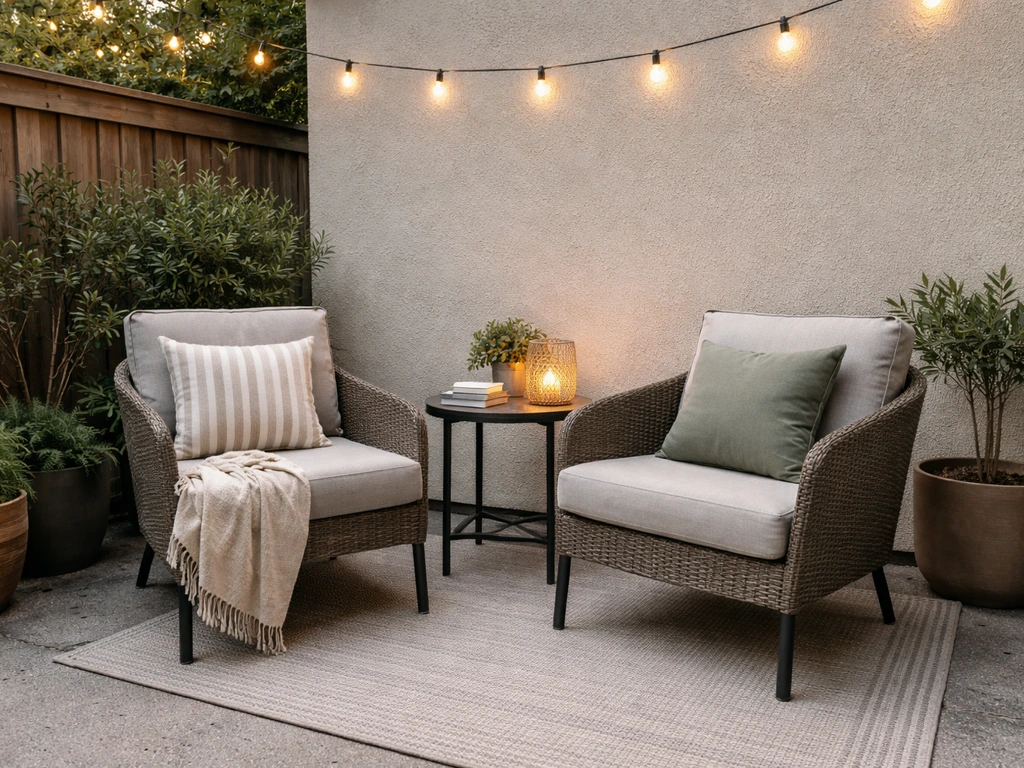
String lights overhead are the single most transformative lighting choice for small patios. They draw the eye upward, define the space as a "room," and create warm ambiance at night that makes even a plain concrete slab feel special. Hang them from hooks on the house wall to a hook on a fence post, or string them under a pergola or shade cover. Add a small solar or battery-powered lantern on the table, and a few flameless candles or LED candles for the railing or shelves. Three light sources at different heights, overhead, mid-level, and low, create depth and warmth without any wiring required.
Vertical lines and height
Tall, narrow elements draw the eye upward and make a small patio feel taller and less boxed-in. A tall trellis panel with climbing vines, a floor-to-ceiling curtain panel on one side, or a vertical garden wall all create this effect. Even choosing a table umbrella or a tall standing planter over a short, wide one plays this trick. Height perception matters as much as floor area perception.
Privacy, sun, and wind protection that actually fits the decor
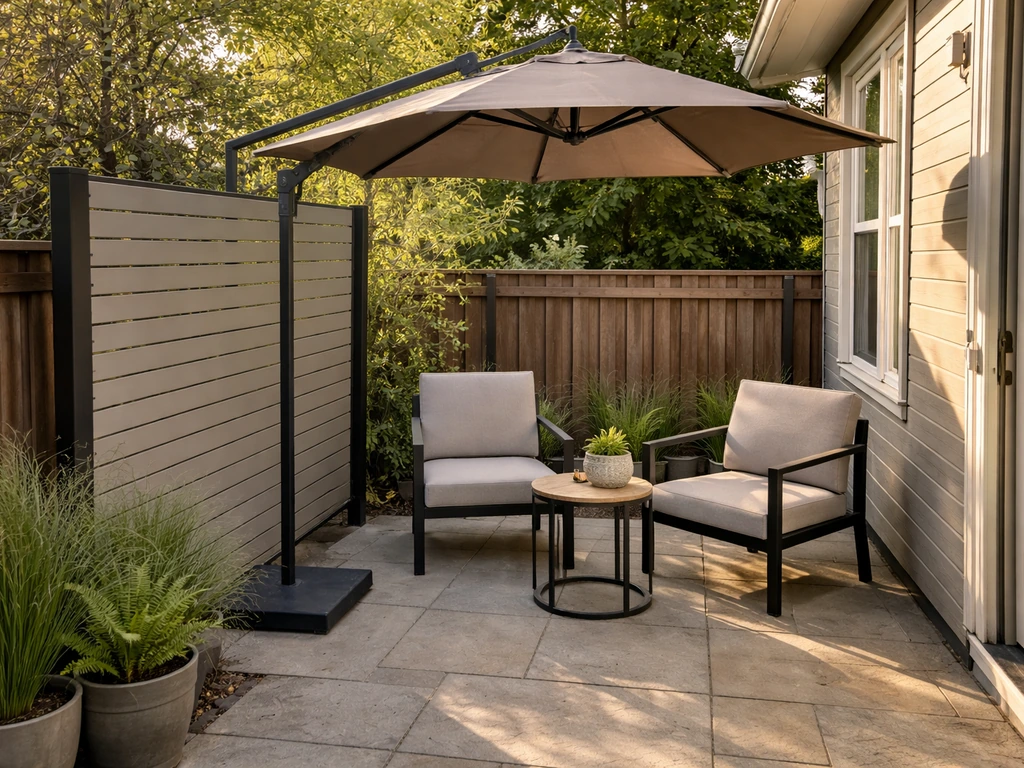
A small patio that bakes in afternoon sun or sits exposed to neighbor sightlines is one you won't actually use, no matter how nicely it's decorated. Privacy and weather protection aren't just functional upgrades, when done well, they become part of the decor itself.
Shade options for small patios
A freestanding cantilever umbrella is ideal for small patios because the base can sit outside the seating area while the canopy extends overhead, no center pole eating up table space. For very small patios, a wall-mounted retractable awning is another excellent option that disappears when you don't need it. If you're ready for a more permanent upgrade, a simple pergola kit with a polycarbonate or fabric cover creates real shade and gives you a structure to hang lights, plants, and curtains from, turning a functional upgrade into a design anchor. A patio cover also makes the space genuinely usable during light rain, which dramatically extends how much you actually use it.
Privacy screens that look intentional
Privacy screens have come a long way from plain reed fencing. Laser-cut metal panels, slatted wood screens, and stretched outdoor fabric panels all work as both privacy barriers and decorative features. Lattice panels with climbing plants like jasmine or clematis give you privacy that softens over the season as the plants fill in. Tall planters with ornamental grasses or bamboo (in containers, so it doesn't spread) create a living screen that moves in the breeze and looks beautiful.
For apartment and condo patios specifically, outdoor privacy screens that attach to railings with zip ties are a simple no-drill solution. For more specific ideas on styling, layout, and budget upgrades, see this guide on how to decorate a small condo patio.
Wind and screening
If wind is your main issue, outdoor curtain panels on one or two sides of the patio block wind while softening the space aesthetically. Use curtain panels on a tension rod or a ceiling-mounted curtain track and choose sunbrella-grade or outdoor-rated fabric so they hold up through weather. For a more serious wind problem, or if bugs are the issue, a screened patio enclosure is worth considering. Screening in a patio is a manageable DIY project that transforms a patio you avoid into one you use every day. Decoration and screening work together well: the enclosed space becomes easier to furnish and decorate because it functions more like a room.
Finishing touches: the details that pull it all together
Once the layout, furniture, and protection elements are sorted, finishing touches are what make a small patio feel complete and personal rather than staged. These are also the easiest things to swap seasonally to keep the space feeling fresh.
Outdoor rugs
An outdoor rug is one of the highest-impact, lowest-cost upgrades you can make. It visually anchors the seating area, adds color and pattern, and makes a bare concrete or wood deck surface feel like a real room. Size matters: on a small patio, choose a rug that fits under the front legs of your furniture at minimum, or ideally under all four legs of chairs when they're pulled out. A rug that's too small floats awkwardly and makes the space feel more fragmented. Polypropylene outdoor rugs are the most practical, they resist moisture, fade, and mildew and can be hosed off when they get dirty.
Plants and containers
Plants are non-negotiable on a small patio, they bring life, soften hard edges, and add color without the visual weight of more furniture. The trick is container discipline: choose two or three larger statement pots rather than twelve small ones scattered around. A single large pot with a bold plant (elephant ear, bird of paradise, a citrus tree) makes more impact and takes up less aggregate floor space than a dozen four-inch terra cotta pots. Use wall planters, railing planters, and hanging planters to get plants off the floor. Herbs in railing-mounted planters are a particularly practical choice, they look great and you can use them when you cook.
Wall art and vertical decor
Blank fence or wall space is wasted opportunity on a small patio. A few outdoor-rated wall art pieces, metal wall sculptures, ceramic tiles, a small chalk or slate sign, add personality without touching the floor. Group two or three pieces together in a loose gallery arrangement rather than spacing them evenly and awkwardly across the whole wall. Woven wall hangings and macrame work well in covered patio situations where they won't get saturated in rain. One or two pieces of wall art plus a mirror plus a wall-mounted plant shelf is usually the sweet spot for a small patio wall, more than that and it starts to feel cluttered.
Seasonal updates without starting over
The beauty of a well-planned small patio is that you can shift it seasonally with just a few swaps. Change out cushion covers (not the whole cushion) for a different season's palette. Swap a summer plant for fall mums or winter evergreen branches in the same large pot. Add a throw blanket to seating as temperatures drop. Swap string lights for warmer Edison bulbs in fall and winter. These small rotations keep the space feeling current and intentional without requiring a full redecorating effort. If making a small patio cozy for cooler months is a priority, that's a specific extension of this same process worth exploring in more depth.
A quick checklist before you start buying anything
- Measure your patio and mark the dimensions on paper — note the door swing, any steps, and fixed obstacles
- Decide on one primary function: dining, lounging, or plants/garden display
- Identify your two biggest comfort problems: too much sun, too little privacy, wind, bugs, or lack of storage
- Choose a furniture footprint that leaves at least 30 inches of clear walkway from the door to the seating area
- Pick a color palette of two neutrals and one accent before buying any cushions, rugs, or decor
- Plan vertical elements first (lights, plants, screens) before adding floor-level pieces
- Shop for multi-function pieces: storage ottomans, folding chairs, railing planters, wall-mounted shelves
- Address shade or privacy before finalizing decor so your covers and screens can double as design features
A small patio is genuinely one of the more satisfying spaces to design because constraints force good decisions. You can't hide clutter behind a big sectional or fill space with random stuff, everything has to earn its place. That discipline is actually what makes small patios look so good when they're done right. Start with your measurements, pick your purpose, and work outward from there. If you want a step-by-step approach, focus on the basics first and build a layout that looks great and feels functional outdoors Start with your measurements, pick your purpose, and work outward from there.. You'll have a space worth spending time in before the season is over.
FAQ
Can I put seating directly beside a door on a small patio without making it feel cramped?
Yes, but only if you can keep a clear path. If your patio is entered through a door within the seating area, use a smaller seating footprint (for example, a bistro set or two chairs) and route traffic along one side. Do a quick test by measuring from the door swing edge to the nearest chair, then confirm you can still move through without nudging furniture or stepping over rugs.
What size dining table works best for a small patio if I want chairs to fully pull out?
For dining, stick to a table size that leaves room for pulling chairs out. A good rule is to plan for about 30 to 36 inches of clearance around the chair edge where people will sit and stand, not just the table diameter. If you cannot achieve that, choose two chairs plus a bench, or use a drop-leaf, bistro, or counter-height table with stools that tuck in.
I love plants, but I worry they’ll make my patio feel messy. What’s the best approach?
If you want greenery but limited walking space, prioritize vertical and off-floor options. Use two or three larger planters, then add wall-mounted shelves, railing planters, or a tall narrow planter in a corner. Avoid scattering many small pots, because they create visual clutter and make maintenance harder.
How do I decorate a small patio that gets harsh afternoon sun and strong wind?
Choose outdoor-rated fabrics and planters, then design around sun exposure. In heavy afternoon sun, favor light-colored cushions, UV-resistant furniture finishes, and shade solutions like a cantilever umbrella or a retractable awning. For wind exposure, use planters with weight (heavy bases or anchored containers) and consider outdoor curtain panels on one or two windward sides.
Where should I place an outdoor mirror so it actually makes the patio look larger?
Use a mirror, but place it intentionally. Mount it where it reflects either sky, a bright garden area, or a light-colored wall, and avoid reflections of clutter, garbage bins, or a dark fence. Also make sure the mirror is weather-rated with a sealed frame so it doesn’t haze or corrode outdoors.
What’s the easiest way to hang string lights on a small patio without blocking movement?
If you’re using string lights, aim for at least three different heights to create depth. Start with hooks or anchors at the house or fence line, then add a mid-level line (for example, along a pergola) and a low accent light on the table or near seating. Keep the strand lengths tight and evenly spaced so the lights don’t sag into the walkway.
How many different “areas” (dining, lounge, plants) should I try to fit into a tiny patio?
If your patio is under 100 square feet, it usually looks best with one main zone and one small secondary zone. For example, keep dining as the main zone, then add only a compact side table for a reading accent. Adding two seating styles plus a full plant display plus a fire pit often competes for space and attention.
What can I change seasonally on a small patio without redoing my whole layout?
Pick the furniture you can live with for the full year and make “style swaps” seasonal. Update cushion covers, swap throws, change one or two planters, and rotate lighting temperature (cool to warm bulbs) rather than replacing heavy pieces. This keeps the layout stable while refreshing the look.
How do I choose the right outdoor rug size so it doesn’t make the patio look smaller?
A rug that’s too small makes a small patio feel chopped up. Aim for the rug to sit under at least the front legs of chairs and the seating area, and ideally under all legs when chairs are pulled out for dining. If you have an irregular shape, choose a rug size that still covers the seating zone uniformly rather than trying to match every edge.
What color strategy works best for small patios that already have dark fences or walls?
Start with one anchor color for the larger surfaces and keep accents controlled. Use light, cool tones on walls, cushions, and larger items, then add one warm accent color in small quantities (pillows, a planter, or a lantern). If your patio has a fence, painting it light can amplify the effect because it reduces “dark blocks” at eye level.
Next Articles
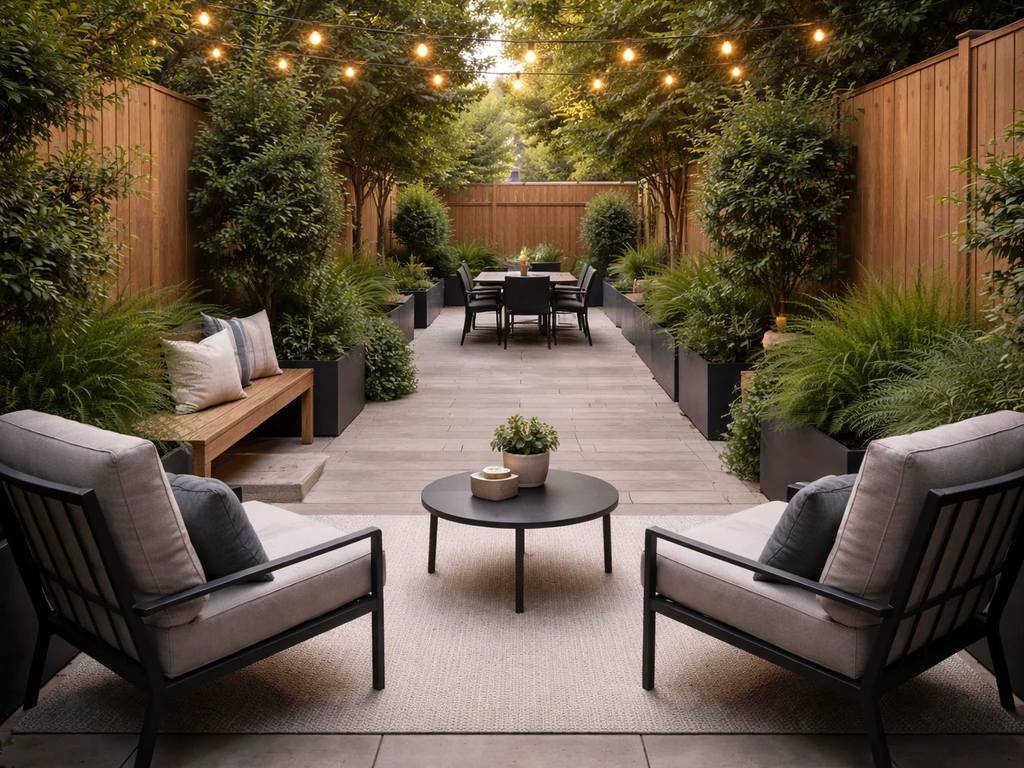
How to Decorate a Long Narrow Patio: Layout Tips
Practical DIY layout and decor tips to widen a long narrow patio using zoning, furniture spacing, lighting, greenery, an
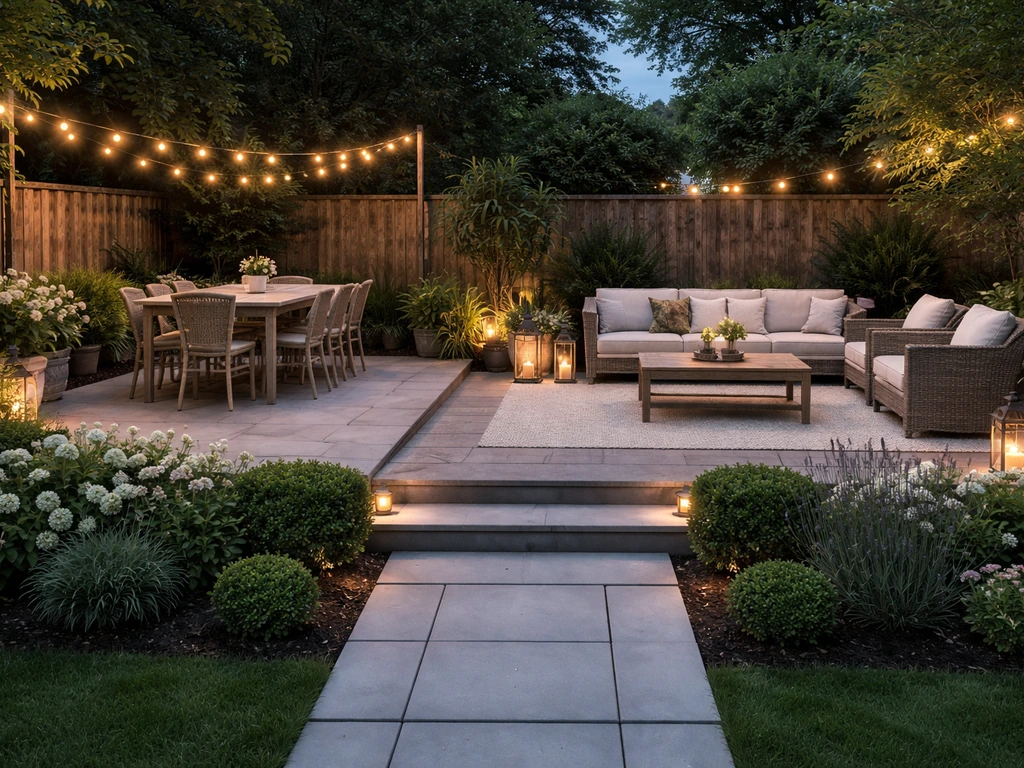
How to Decorate a Rectangular Patio Step by Step
Step-by-step plan to decorate a rectangular patio with smart layout, zones, furniture fit, lighting, plants, and seasona
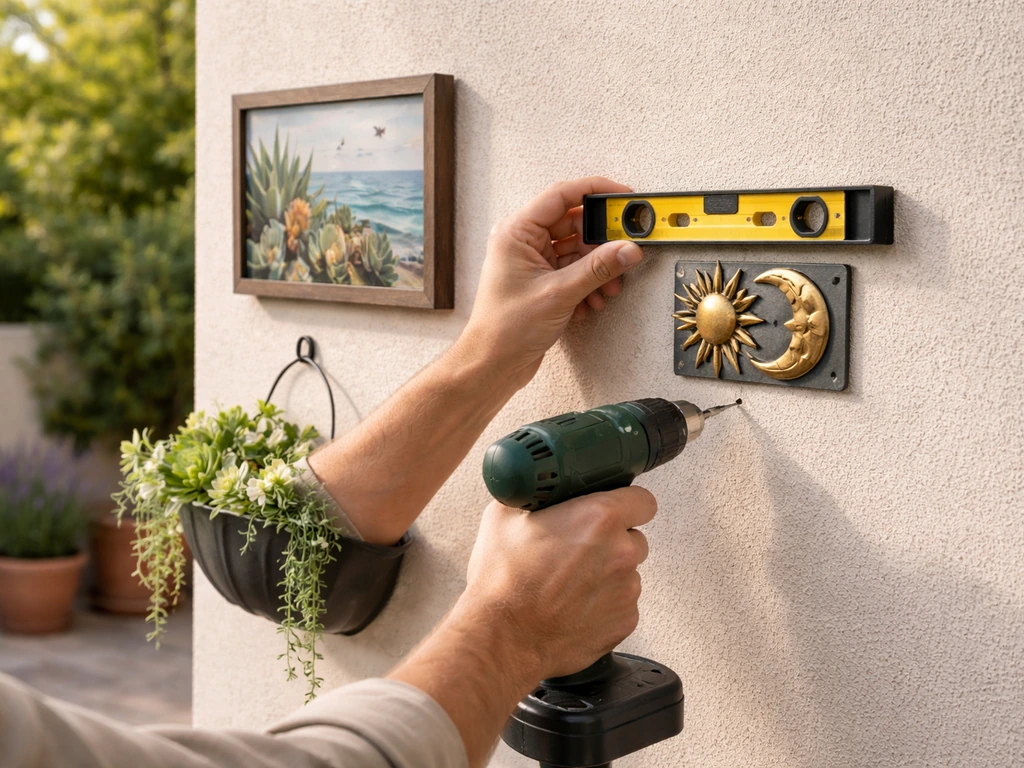
How to Decorate a Patio Wall: DIY Ideas and Mounting Tips
DIY patio wall decor for brick, stucco, wood, concrete, or siding with weatherproof mounting tips and maintenance.