The best way to shade a west-facing patio is to combine a deep overhead cover (a retractable awning, fixed canopy, or pergola with solid or louvered roof) with a vertical screen or side panel on the southwest side. That two-part approach is what actually blocks late-day sun because afternoon sun on a west-facing patio comes in low and at an angle, punching right under any shade that only covers the top.
How Do You Shade a West Facing Patio: DIY Options

Felix Brennan
7 Jun 2026
Why west- and south-facing patios get the hardest-to-shade sun
A west-facing patio takes the full brunt of afternoon and evening sun, roughly from 1 PM until sunset. That is not just a comfort issue, it is a physics issue. In the morning, the sun is high enough that a simple overhead cover handles most of it. By mid-afternoon on a west-facing space, the sun has swung around and dropped lower in the sky, so the angle is much shallower. Shade structures that work beautifully for overhead sun suddenly fail because the sun is practically coming in sideways. This gets even worse in autumn and winter, when the sun arc is lower across the entire day, making that glancing afternoon angle even more severe.
South-facing patios face a similar but slightly different version of this problem. They get intense midday sun from overhead all day long, but also catch that low southwest sun in the afternoon. If your patio faces somewhere between south and west (the classic southwest-facing patio), you are dealing with both challenges at once: harsh overhead midday sun and low-angle late-day glare. Both situations demand a shading solution that accounts for angle, not just vertical coverage.
Quick assessment: measure, map sun hours, and check your space
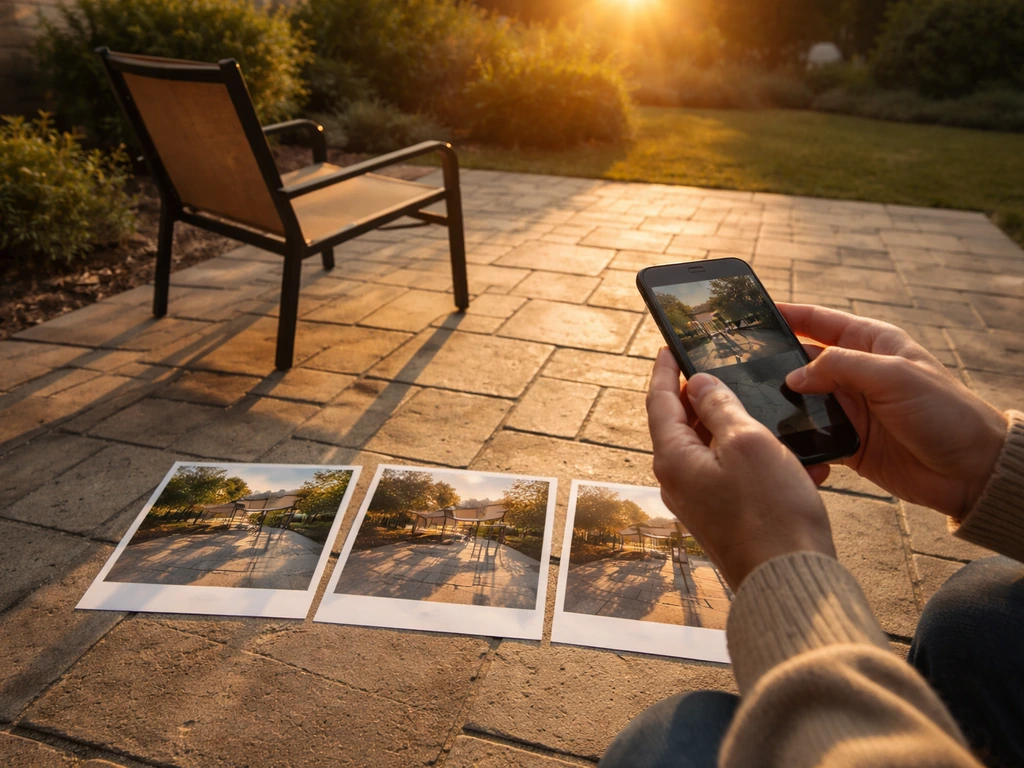
Before you spend any money, spend 20 minutes doing a real assessment. Walk your patio at 2 PM, 4 PM, and 6 PM on a sunny day and take photos each time. Notice exactly where the sun is hitting, what angle it is coming from, and which parts of the space are already shaded by your house or neighboring structures. Those photos tell you more than any diagram.
Measure the patio footprint accurately. Width and depth both matter because shading products are sized by those numbers. Also note the height of your house wall or eave where you would attach anything, and check whether you have posts, columns, or fencing on the sides that could serve as anchor points for a sail or screen.
For a more precise sun-angle picture, free tools like Sun Surveyor and PhotoPills let you set your exact location, date, and time to visualize exactly where the sun sits in the sky above your patio at any hour. This is especially useful for figuring out whether a neighbor's wall or tree line will give you any free shade in the late afternoon. Run it for both summer and winter dates, because the low winter sun angle on a west-facing patio is often the worst-case scenario you need to design for.
- Measure patio width and depth in feet. Write it down.
- Note the height of any wall, eave, or post you could attach shade hardware to.
- Photograph the patio at 2 PM, 4 PM, and 6 PM to see where the sun actually lands.
- Use a sun-tracking app (Sun Surveyor, PhotoPills) to check the winter low-angle sun path.
- Check your HOA rules or local permit requirements for permanent structures above a certain size. Many areas require a permit for anything attached to the house or over a certain square footage.
- Identify whether you have high-wind days regularly, because that affects which shade systems are practical.
Temporary shade options that work today
If you want relief this weekend, these options can be set up fast with no tools or permits. If you want a quick answer, the most reliable ways to shade a west-facing patio are offset cantilever umbrellas, retractable awnings, and angled shade sails or side panels shade on my patio.
Offset cantilever umbrellas
A large offset (cantilever) patio umbrella is the single fastest fix. Unlike center-pole umbrellas, a cantilever umbrella lets you swing and tilt the canopy to track the low western sun rather than just blocking overhead light. Look for one with a 10- to 13-foot canopy diameter and a tilt-and-rotate mechanism. Position it so the base sits to the east side of your seating, and angle the canopy toward the afternoon sun. The limitation is that really low sun at 5 or 6 PM still slips under even a tilted umbrella, which is why you may want to pair it with a privacy screen or shade panel on the west side.
Freestanding market awnings and pop-up canopies
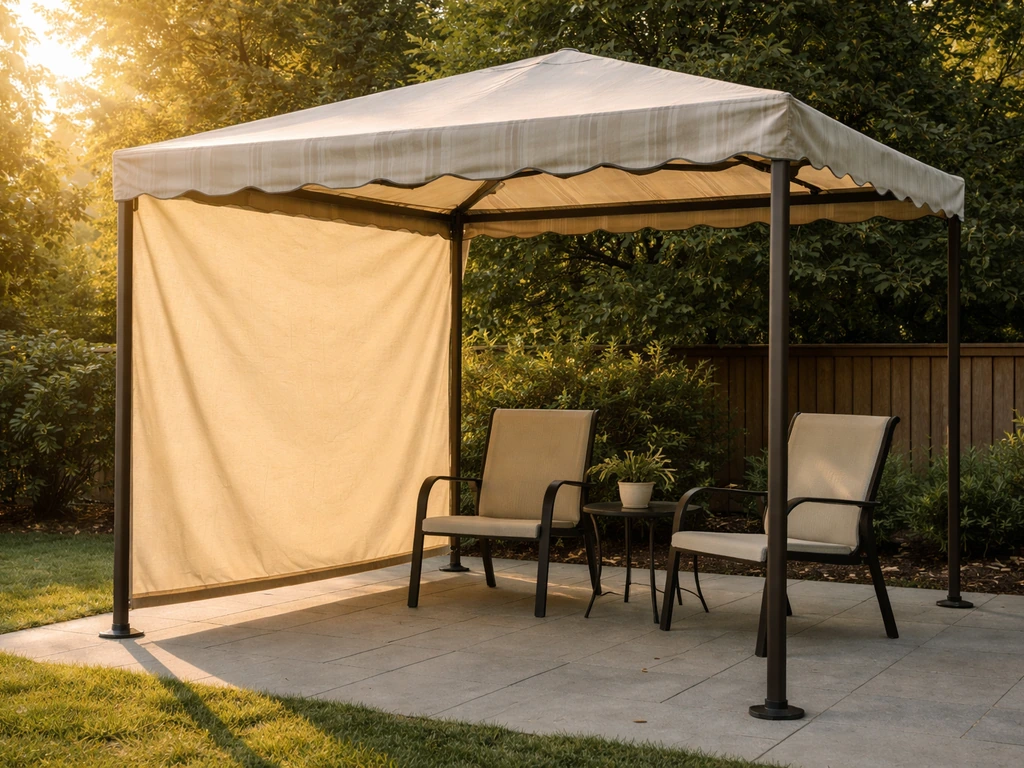
A freestanding market-style canopy (the kind with four legs and a fabric roof) can cover a dining or lounge area immediately. For afternoon sun, close the side panel that faces west. These are not wind-proof, so stake the legs down on any day with a breeze over about 20 mph. They are also not a long-term solution because UV exposure degrades most budget canopy fabrics in a season or two. That said, for testing where you actually want permanent shade before you commit to a bigger install, they are perfect.
Outdoor shade curtains and roll-up shades
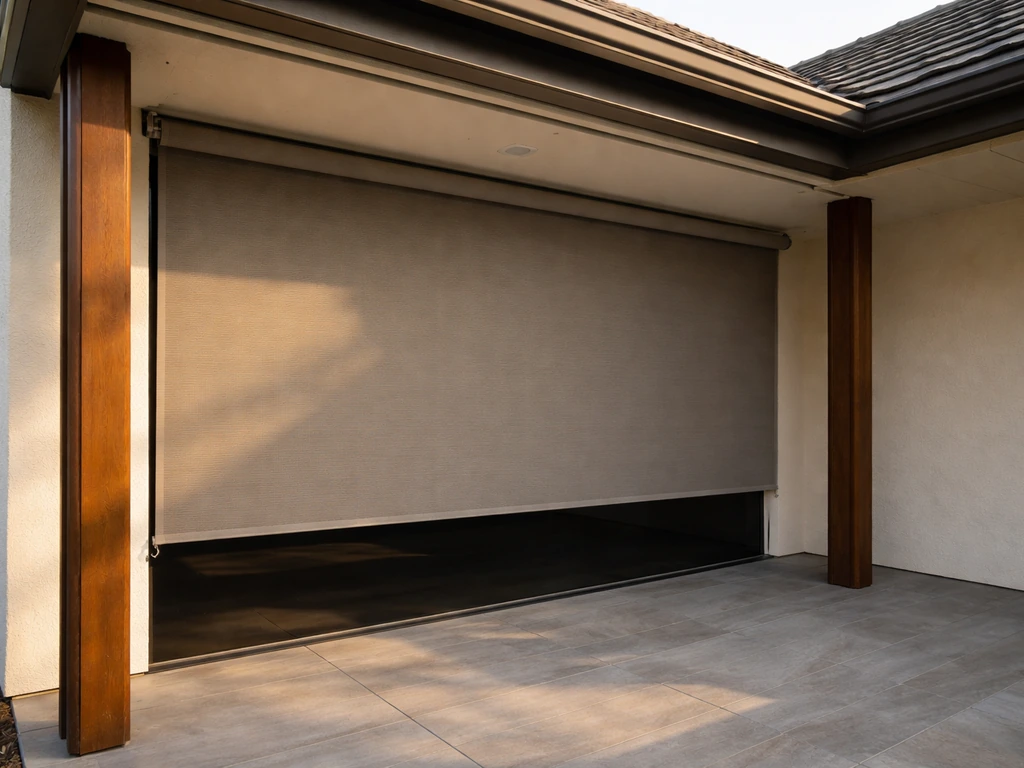
If your patio has a roof overhang, beam, or pergola frame already, outdoor roller shades or curtain panels hung on the west side work well for that low-angle afternoon sun. They address the vertical plane that overhead structures miss. Use a solar-screen fabric rated at 90% or higher openness factor if you want airflow, or a tighter weave if glare is your main problem. These hang from a rod or track, cost $50 to $200 per panel depending on size and fabric quality, and take about an hour to install.
Permanent shading installs that really solve the problem
If you are done with seasonal setups and want something that works every day without thinking about it, these are the options worth investing in.
Retractable awnings
A retractable awning mounted to the house wall is one of the most popular permanent solutions for west and south-facing patios, and for good reason. It gives you shade when you need it and lets you retract it when you want open sky or need to avoid wind stress. The key sizing rule: the awning should extend past the edges of the seating area it covers, not just match it exactly.
That extra width and depth accounts for the changing sun angle as the afternoon progresses. If you are trying to figure out how to shade patio from sun effectively, focus on the afternoon sun angle and choose an awning with the right projection for your seating depth. Most manufacturers, including Solera by Lippert, recommend sizing the projection (how far it extends from the wall) so it covers your seating plus a comfortable buffer.
For a west-facing patio specifically, choose an awning with enough projection to throw shade over the full depth of your seating at a 45-degree sun angle. A rule of thumb: for every foot of patio depth you want shaded at 4 PM, you need roughly 1.2 to 1.5 feet of awning projection. Most residential retractable awnings come in projections from 8 to 14 feet. Motorized models with wind sensors that auto-retract during gusts are worth the extra cost if your area gets afternoon storms.
Fixed canopies and solid roof structures
A fixed aluminum or polycarbonate canopy attached to the house provides permanent overhead protection and handles rain as well as sun. These are typically attached to the fascia or wall and supported by posts at the outer edge. For low-angle afternoon sun, a fixed canopy alone still leaves you exposed on the west side, so plan for side panels or drop screens as part of the build. Water runoff needs to be thought through: some aluminum canopy systems channel water through hollow posts directly to the ground, which keeps the patio dry during rain. Make sure whatever you install pitches away from the house with at least a 1/4-inch-per-foot slope.
Pergolas (standard and louvered)
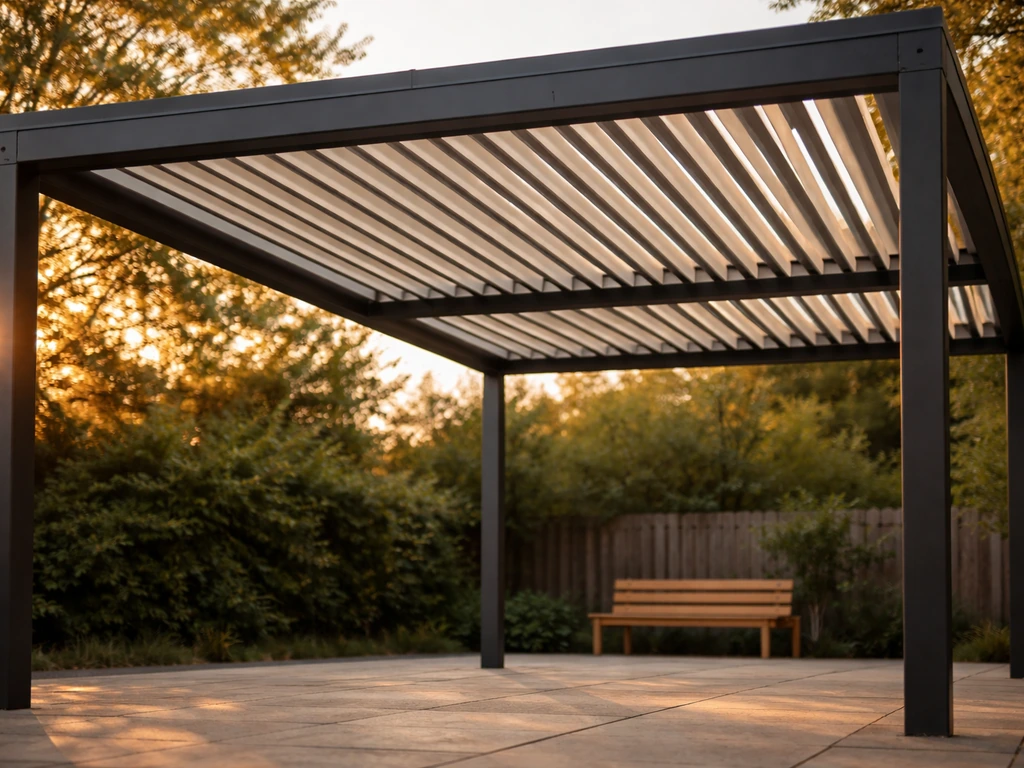
A pergola with open rafters gives some overhead shade but does not block low-angle western sun effectively on its own. If you want a pergola to actually solve your west-facing patio problem, either add a solid or fabric roof panel, hang shade curtains from the side beams, or choose a louvered pergola system. Adjustable louvered pergola roofs (like those offered by LuxPatio and similar brands) let you angle the louvers to block low afternoon sun while still maintaining airflow, which is genuinely useful in hot climates where trapping heat under a solid roof makes things worse, not better. A basic DIY pergola kit can cost $1,500 to $5,000 in materials; a louvered motorized system runs $8,000 to $25,000 installed depending on size.
Shade sails and screen or partial enclosure strategies for low-angle sun
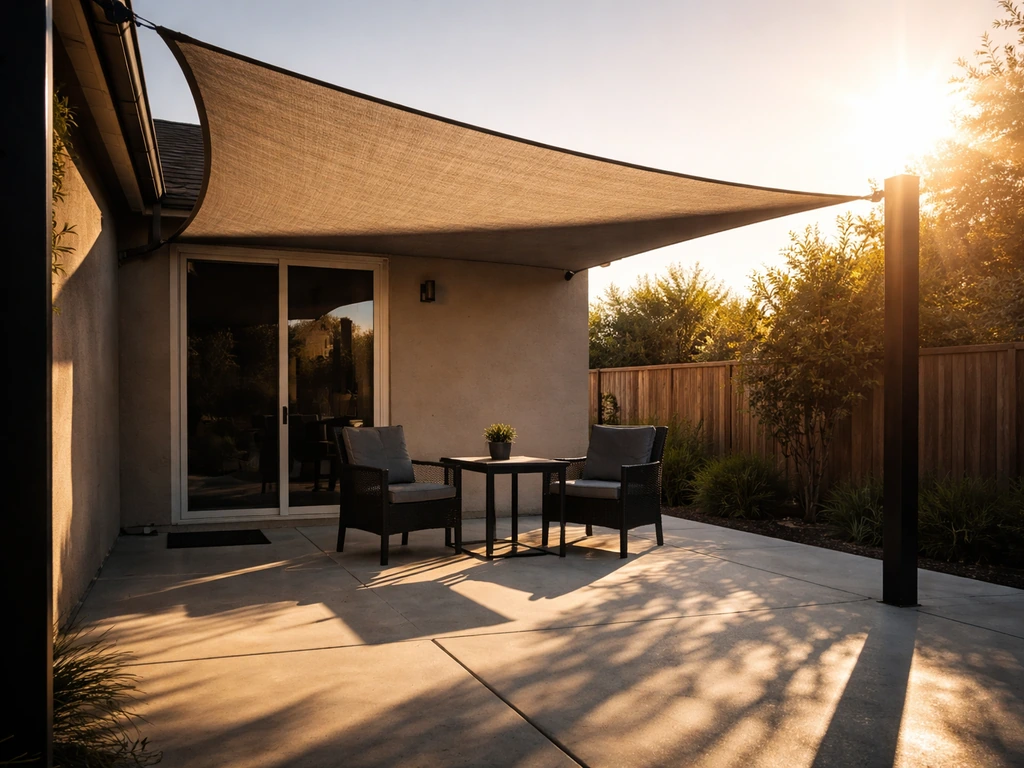
Shade sails are triangular or rectangular fabric panels stretched tightly between anchor points. They are popular because they look modern and cover large areas affordably. The challenge for west-facing patios is that a single horizontal sail does not block low afternoon sun. The fix is to install a sail at an angle (not flat) so one edge is higher on the east side and lower on the west side, effectively creating a sloped barrier that catches the low incoming light.
If you need a direct, purpose-built approach to block west sun on patio without trial and error, an angled sail or a west-side solar screen panel is usually the quickest adjacent option. You can also combine two sails, one overhead and one at a more vertical angle on the west side.
Installation matters a lot with shade sails. Bob Vila's guidance is clear: set wooden posts in concrete for any freestanding anchor, because the tension loads are substantial. Shade Sails LLC recommends pre-tensioning to about 100 lb and warns against extending multiple corners simultaneously, which increases shock loads in wind. Use hardware with turnbuckles so you can re-tension the sail as the fabric stretches over time. A properly tensioned sail has no sagging in the middle. Coolaroo's commercial-grade sails offer up to 95% UV block with a 15-year warranty, which gives a useful benchmark for comparing other products.
For the most effective low-angle sun blocking, consider a partial enclosure strategy. This means adding a screen or solar shade panel along the west side of your patio, either freestanding or attached to posts. Homeowners who want a more complete solution sometimes screen in the west-facing side of a covered patio entirely, which also reduces glare and keeps insects out. This crosses into patio enclosure territory, and it is one of the most livable upgrades available for a west-facing space because it handles sun, glare, and bugs in one move.
Placement, mounting, height, and wind and water considerations
Where you place and how you anchor your shade structure matters as much as which type you choose. Here are the practical details that most guides skip over.
Height and projection
Mount overhead shades as high as your wall attachment allows, typically at the eave or fascia level, 8 to 10 feet off the ground. Higher mounting gives more clearance under the shade and allows a steeper pitch, which improves rain runoff and increases the effective shading area at lower sun angles. A shade mounted at 10 feet and extended 12 feet out will block more low afternoon sun than one mounted at 8 feet with the same 12-foot projection.
Mounting surfaces
Attach to structural elements only: into studs or blocking in a wood-frame wall, into masonry with proper anchors, or into an existing structural beam. Never mount a retractable awning or canopy bracket into just siding or trim. If your patio wall is stucco or masonry, use sleeve anchors or wedge anchors rated for the load. For shade sail anchors, anything freestanding should have posts set in at least 18 inches of concrete to handle the tension and wind loads.
Wind management
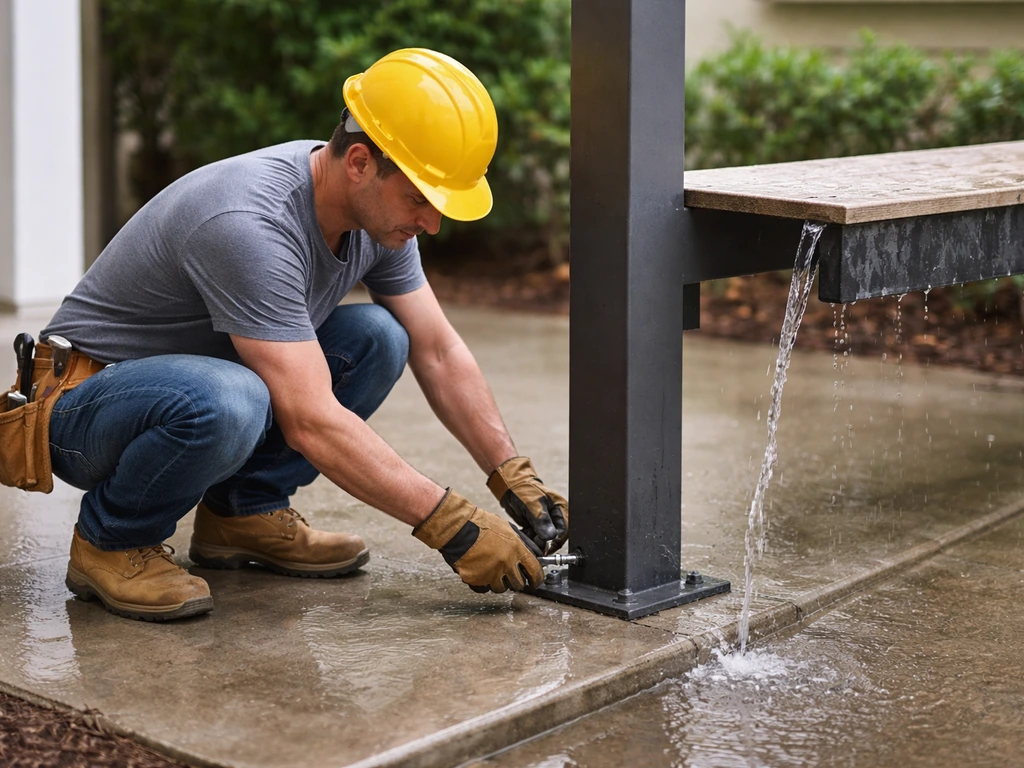
Wind is the biggest enemy of most shade structures. Retractable awnings should be retracted when winds exceed 25 to 30 mph; motorized versions with wind sensors do this automatically. Shade sails should come down in high winds, as Shade Sails LLC explicitly states, because the concentrated tension loads at corner anchors can pull posts or wall brackets loose. Fixed canopies and pergolas need to be engineered for local wind loads; California's code, for example, requires structural members (not flexible fabric) to handle at least 10 psf vertical live load plus wind pressure requirements, and most jurisdictions have similar or stricter rules.
Water and drainage
Any solid or near-solid overhead cover collects rain. Pitch the structure away from the house (minimum 1/4 inch per foot, ideally more) and make sure water has somewhere to go that does not pool on the patio or run into the house. Some aluminum pergola and canopy systems route water through hollow posts, which is an elegant solution. For fabric shades and sails, use a shade cloth with open weave that allows water to pass through rather than collect, then drain in a single low spot during heavy rain.
Common mistakes to avoid
- Sizing the awning or sail to match the patio exactly rather than extending beyond the edges, which leaves the margins unshaded as the sun angle shifts.
- Mounting only overhead cover and ignoring the low-angle western sun that comes in horizontally in the late afternoon.
- Setting shade sail posts without concrete, or using thin-gauge hardware, causing gradual lean and fabric sag.
- Forgetting to account for winter sun angles, which are lower and hit the patio from a more extreme southwest angle.
- Skipping permits for structures over 200 square feet or attached to the house, which can cause problems at resale.
Costs, materials, and maintenance: what to choose and what to watch out for
| Option | Typical Cost Range | Best For | Maintenance | Wind Sensitivity |
|---|---|---|---|---|
| Offset cantilever umbrella | $150–$600 | Quick fix, small seating area | Store in winter; rinse fabric seasonally | High – retract in wind |
| Outdoor roller shades / curtains | $50–$300 per panel | Blocking low-angle side sun | Rinse with hose; roll up in storms | Medium – roll up in wind |
| Shade sail (1–2 panel) | $100–$500 DIY materials | Open patios with anchor points | Rinse with hose; remove in high winds | High – remove in storms |
| Retractable awning | $800–$4,000 installed | Flexible daily use, attached to house | Annual lubrication of arms; clean fabric | Medium – retract at 25–30 mph |
| Fixed canopy / aluminum cover | $2,000–$8,000 installed | Permanent rain + sun protection | Annual inspection of fasteners | Low if properly engineered |
| Standard pergola + shade | $1,500–$6,000 DIY | Freestanding, decorative shade | Re-stain wood every 2–3 years | Medium depending on roof type |
| Louvered pergola (motorized) | $8,000–$25,000 installed | Full sun/airflow control, high-end finish | Clean louvers; lubricate motor annually | Low – adjustable in wind |
What materials to look for
For fabric shade products (sails, roller shades, awning fabric), look for HDPE (high-density polyethylene) mesh or solution-dyed acrylic. HDPE mesh allows airflow and drains rain, making it better for sails and open panels. Solution-dyed acrylic like Sunbrella holds color better and resists UV breakdown for 5 to 10 years with basic care. Coolaroo's commercial-grade HDPE offers up to 95% UV block, which is a good performance benchmark to compare other products against. Avoid cheap polyester shade cloth; it fades, sags, and becomes brittle within a season or two in direct western sun.
For structural components, powder-coated aluminum is the low-maintenance choice for frames, posts, and awning arms. It does not rust, does not need painting, and handles temperature swings without warping. Pressure-treated wood is fine for DIY pergola posts set in the ground, but any horizontal wood members in direct sun exposure should be sealed or stained every two to three years.
Maintenance basics
Most shade fabrics just need a rinse with a garden hose a few times per season to remove dust, pollen, and debris. For more stubborn staining, Coolaroo recommends mild soap and water with a soft-bristled brush, followed by a strong rinse with fresh water. Avoid bleach on most shade fabrics as it degrades the UV-protective coating. For retractable awning arms, a light spray of silicone lubricant on the pivot points and gear mechanism once a year keeps the operation smooth. Inspect all mounting hardware, anchor bolts, and turnbuckles at the start of each season and tighten anything that has worked loose over winter.
Making the shaded space actually comfortable
Blocking sun is only half the job. A shaded but sealed-off west-facing patio can still feel like an oven if there is no airflow. If you are adding side screens or panels to block low-angle sun, use solar screen fabric with at least a 5% to 10% openness factor so air can move through. Louvered pergola roofs help here too, since you can angle them for sun blocking while still allowing cross-ventilation.
For patios that get serious afternoon heat, adding a ceiling fan under a fixed canopy or pergola roof makes a dramatic difference in perceived comfort, even on days when the temperature is still high. If you want to go further toward a fully enclosed and comfortable outdoor room, exploring screened patio enclosure options for the west-facing wall is a logical next step that combines glare control, bug protection, and year-round usability in one structure.
FAQ
Can I shade a west-facing patio with only an overhead umbrella or does it always need side coverage?
Most of the time you will still need some west-side control. On a west exposure the late sun arrives low and angled, so an overhead cover can leave strong glare and heat coming in from the southwest edge. A practical test is to watch where the bright hotspot lands at 5 to 6 PM, if it hits the sides or under the canopy edge, add a vertical screen or pair an umbrella with a west-side panel.
What’s the best way to position an offset cantilever umbrella for low afternoon sun?
Put the umbrella base to the east side of your seating so you can tilt and rotate the canopy to aim the shade toward the west, not straight down. Then check coverage at multiple times, especially 4:30 PM and 5:30 PM, because the lowest sun often slips under a tilted canopy. If the last hour still gets glare, plan a short west privacy screen to catch that remaining sideways light.
How do I choose awning projection if my seating area is irregular or extends under the walkway?
Measure the seating depth from the house wall to the farthest sitting point that must be shaded, and include a small buffer so the awning remains effective as the sun angle shifts. If you have an L-shaped or step-out patio, size projection to the deepest point that matters, then consider a second narrower awning section or a side screen to cover the offset portion instead of trying to force one awning to cover everything.
Should I mount retractable awnings into siding, or is the wall surface enough?
Mount into structural elements, studs or blocking for wood-framed walls, or properly rated anchors for masonry or stucco. Siding and trim are not reliable for repeated loads and wind stresses. If you cannot see stud locations, use a stud finder rated for your wall type or open a small inspection area before ordering the awning.
How windy can it be before my shade sails or screens should come down?
For many homes, a safe rule is to remove or retract in high gust conditions because sail corners and tension loads concentrate stress on anchors. If your area regularly exceeds around 25 to 30 mph gusts, plan for seasonal take-down and use quick-release hardware if possible. For screens that are attached only at a top rail, wind can cause side load, so secure them with additional posts or braces if the panel is more than a few feet tall.
What openness factor should I use on solar screen fabric for a shaded west patio?
If airflow is important, choose solar screen fabric with at least 5% to 10% openness, this keeps the space cooler and reduces that closed-in feeling. If glare reduction is the priority, you can go tighter weave but expect less cooling. A good decision aid is to compare material by looking at how much daylight still reaches the seating, if it still looks harsh at 4 to 5 PM, move toward lower openness.
Do I need a slope or drainage plan for canopy and awning systems?
Yes, anything that collects rain needs a path to prevent pooling and water running toward the house. Use a minimum 1/4-inch-per-foot pitch away from the wall, and confirm that runoff routes to a safe discharge point. For systems with hollow posts or built-in gutters, make sure downspouts or drainage outlets are not blocked by landscaping or hardscape.
What patio materials or construction types limit my shading options?
If your patio is on a masonry or stucco wall, anchor rating matters, wedge or sleeve anchors must match the substrate strength. If your patio has limited structural attachment points, you may need freestanding posts for screens, umbrellas, or sail anchors set into concrete. Also consider that some pergola and canopy options require engineered member sizing for local wind loads, which can reduce DIY feasibility if permits are required.
How should I maintain shade fabrics so they last through harsh west sun?
Use rinsing with water a few times per season to remove dust and pollen, for stains use mild soap and a soft brush, then rinse well. Avoid bleach because it can break down the UV-protective coating. For retractable awnings, lubricate pivot and gear points annually, and inspect mounts and turnbuckles at the start of each season so loosened hardware is fixed before summer peak sun.
When is it worth moving from temporary shading to a more permanent enclosure strategy?
If you regularly use the patio in the late afternoon and the biggest complaints are heat and glare, a partial side enclosure is usually the next step because it blocks the low angled sun while also reducing wind-driven glare. If bug control is also a problem, consider a screened wall or full screened side panel so you solve multiple issues at once, rather than repeatedly swapping covers and panels each season.
Next Articles
How to Block West Sun on Patio: DIY Shade Options
DIY ways to block harsh West sun with quick shade fixes and permanent awning, pergola, or shade sail options
What Can I Use for Shade on My Patio: Options
DIY patio shade options from umbrellas to pergolas and sails, with cost, durability, mounting tips, and quick decision h
How to Shade Patio From Sun: DIY Options and Installation
Step-by-step DIY guide to shade a patio from sun with umbrellas, sails, pergolas, awnings, and installs, measurements, a