You can grow productive fruit trees on a patio by choosing dwarf or grafted varieties in 20-gallon-plus containers, planting in a bark-based free-draining mix, watering consistently, feeding through the growing season, and protecting roots over winter. It takes more active management than in-ground growing, but the payoff is real fruit from a small space, and most of the work fits neatly into a seasonal routine you can build once and repeat.
How to Care for Patio Fruit Trees: Complete Guide to Growing

Felix Brennan
15 Jul 2026
Why grow fruit trees on a patio?
The appeal is simple: you get homegrown fruit without needing a garden bed, and you keep full control over soil, sun exposure, and even location. Container trees can be moved to follow the sun, pushed into shelter before a frost, or repositioned when you rearrange your outdoor space. That flexibility matters a lot for small or urban patios where conditions are not always ideal.
There are real limits though, and being clear-eyed about them saves a lot of frustration. Container-grown trees dry out faster, exhaust nutrients more quickly, and need more frequent attention than in-ground trees. You will not get orchard-scale yields from a 25-gallon pot. Fruit production from patio trees is genuinely satisfying, but 'a bowl of figs from your own terrace' is a more realistic mental image than 'enough apples to make cider.' Expect 10 to 40 pieces of fruit per season from a well-cared-for patio apple, more from a fig or citrus in a warm climate.
If you are growing on a raised deck or balcony rather than a ground-level patio slab, weight is a serious practical concern. The 2024 International Building Code designs balconies for roughly 60 pounds per square foot, but a large potted tree in wet soil can easily exceed 150 pounds. Check your local code limits and consider asking a structural engineer before lining a balcony with heavy containers. For ground-level concrete or paver patios, weight is rarely an issue.
Choosing the right patio fruit tree
Rootstock controls the size of the tree far more than the variety name does. For apples, the RHS specifically recommends dwarfing rootstocks like M9 and M26 for container growing. An M9 apple stays under 8 feet even in the ground; in a pot it stays smaller still, which is exactly what you want. For pears, Quince C or Quince A rootstocks produce manageable sizes. For stone fruits, look for trees sold on 'Pixy' (plum/cherry) or 'Gisela 5' (cherry) rootstocks. Citrus sold as 'patio citrus' or 'dwarf citrus' is typically grafted onto Flying Dragon or similar dwarfing rootstock.
When buying, ask the nursery directly: what rootstock is this on, and what is the expected mature height in a container? A reputable supplier will answer that question. Avoid buying bare-root trees marketed purely by fruit variety without rootstock information, especially for apples and pears. The words 'patio,' 'miniature,' or 'ballerina' on the label are helpful signals but not a substitute for knowing the rootstock.
For size planning: in a 20-gallon container, target a tree that will reach 4 to 6 feet tall. In a 30- to 45-gallon container, you can accommodate something closer to 6 to 8 feet. Anything bigger than that becomes genuinely difficult to move and repot. Factor in your own ability to manage the pot from day one.
Best fruit types for containers
Some species simply do better in containers than others, and choosing a naturally container-tolerant fruit type cuts your effort significantly.
| Fruit | Container Suitability | Self-Fertile? | Minimum Pot Size | Notes |
|---|---|---|---|---|
| Fig | Excellent | Yes | 15–25 gal | Thrives with root restriction; prolific in warm climates |
| Citrus (lemon, lime, kumquat) | Excellent | Yes (most) | 15–20 gal | High-input; needs warmth; great on screened patio |
| Apple (on M9/M26) | Very good | Mostly needs partner | 20–25 gal | Needs pollinator unless self-fertile cultivar chosen |
| Pear (on Quince C) | Very good | Mostly needs partner | 20–25 gal | Check pollination group at purchase |
| Peach/Nectarine | Good | Yes (most) | 20 gal | Prone to peach leaf curl; protect in spring |
| Cherry (on Gisela 5) | Good | Depends on variety | 20–25 gal | Self-fertile 'Stella' or 'Lapins' are reliable choices |
| Plum (on Pixy) | Good | Depends on variety | 20 gal | Victoria plum is partially self-fertile |
| Olive | Very good | Yes (mostly) | 15–20 gal | Drought-tolerant; fruit needs warm summer to ripen |
| Blueberry | Excellent | Better with partner | 15 gal | Needs acidic mix (pH 4.5–5.5); ideal for containers |
Figs and lemons are the friendliest starting point for beginners. Both tolerate occasional missed waterings better than stone fruits, both are largely self-fertile, and both give visible results quickly. If you want to grow multiple types, strawberries and blueberries pair very well with patio trees and can share the same general care routine. Tomatoes and herbs work as companions too, though they have their own specific staking and support needs.
Selecting pots and containers
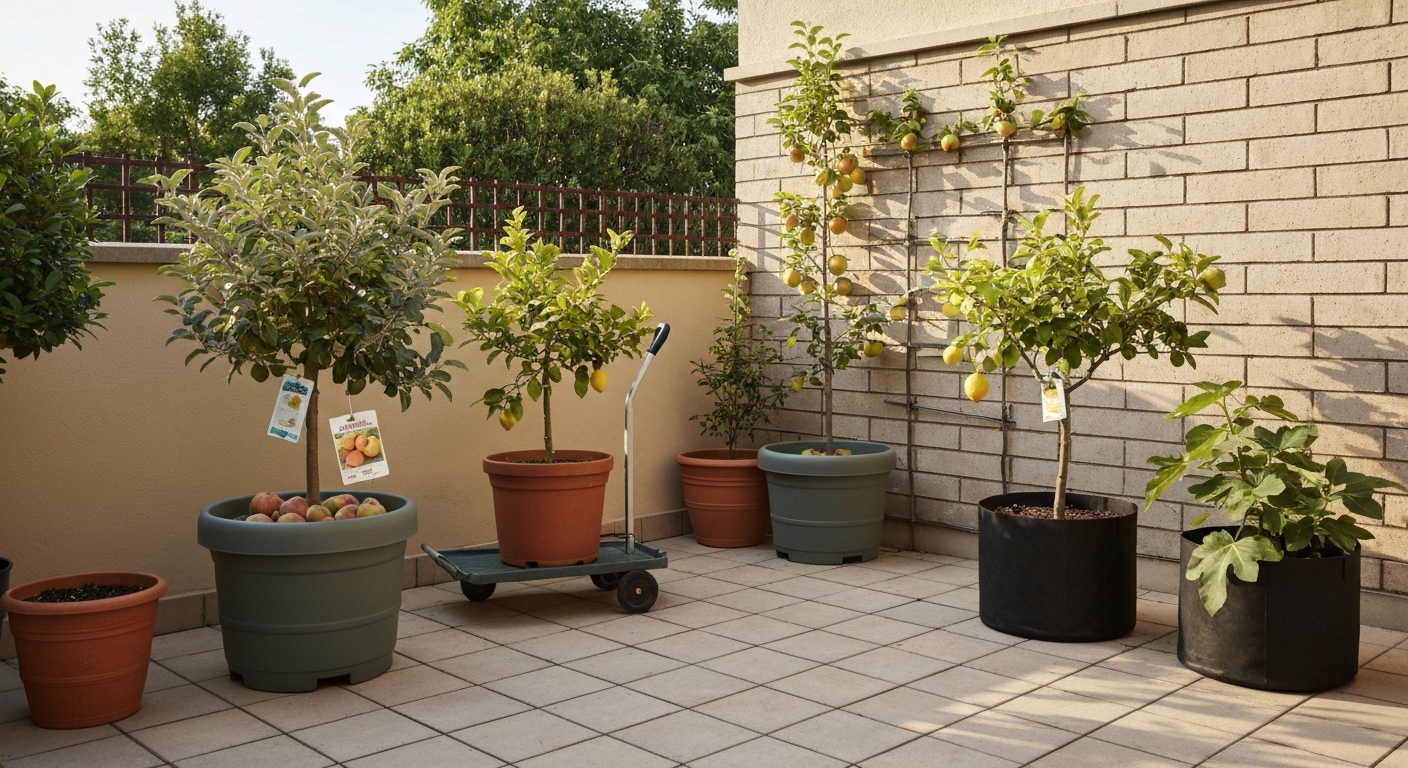
The single most common mistake is starting with a pot that is too small. A practical minimum for any productive patio fruit tree is 20 gallons, which is roughly 21 inches in diameter. Figs can be kept productively in 15-gallon containers, but 20 to 25 gallons gives you a meaningful buffer against heat stress and drought. Larger containers moderate root temperature better, meaning slower swings between hot and cold, which reduces stress on the tree.
Material matters for both weight and drainage. Terracotta looks great but is heavy, fragile, and dries out quickly. Lightweight resin or fibreglass pots mimic terracotta aesthetically at a fraction of the weight and are far more practical for moving. Fabric grow bags (sometimes called Smart Pots) actively air-prune roots, which means the roots branch outward densely instead of circling the container wall. That is genuinely beneficial for long-term tree health, but the trade-off is faster drying: fabric containers lose moisture more quickly than rigid ones and need closer attention in warm weather.
Whatever material you choose, drainage holes are non-negotiable. Aim for at least three to four holes in the base of any container 20 gallons or larger. Elevate pots on feet or a wheeled trolley so holes stay clear and so moving them does not become a two-person emergency. A good wheeled plant caddy is one of the best investments you can make for patio container trees.
Soil and potting mix for patio trees
Never use garden soil in a container. In a pot, garden soil compacts, drains poorly, and creates waterlogged conditions that kill roots. You want a mix that stays loose and drains freely even after repeated watering. A practical recipe that experienced container fruit growers swear by is the '5-1-1' formula: 5 parts bark fines (pine or fir), 1 part perlite or pumice, and 1 part good compost or peat-free potting soil. This mix drains fast, resists compaction, and supports healthy roots.
For blueberries, shift toward an ericaceous (acidic) mix with a target pH of 4.5 to 5.5. Most other patio fruit trees prefer a slightly acidic to neutral pH of around 6.0 to 6.8. You can test with an inexpensive soil pH meter or test strips. If your tap water is very alkaline (above pH 7.5), it will gradually raise soil pH over time and can cause yellowing in citrus and blueberries. Collect rainwater where possible or use pH-adjusting additives.
Add a slow-release balanced fertilizer granule into the mix at potting time. This provides a steady background nutrition while the tree establishes. You will supplement with liquid feeds once growth begins, but the CRF in the mix gives a good baseline from day one.
Planting and repotting step by step
Spring is the ideal time to plant or repot, ideally just before the first flush of new growth. This gives roots maximum time to establish before the demands of summer. If you are planting a bare-root tree, aim for late winter to early spring while the tree is still dormant. Container-grown nursery stock can be planted through spring and into early summer, though you will need to water more attentively if you plant during a warm spell.
- Choose a container at least 20 gallons with adequate drainage holes and place it on a wheeled caddy before filling.
- Add a layer of coarse gravel or broken pot shards over the drainage holes to prevent mix from washing out.
- Mix your 5-1-1 bark-based blend and incorporate a slow-release balanced fertilizer at the manufacturer's recommended rate.
- Fill the pot to about one-third with mix, then sit the tree (still in its nursery pot) inside to judge the final planting depth.
- The graft union — the visible swollen bump near the base of the stem — must sit at least 2 inches above the final soil surface. Never bury the graft union.
- Remove the nursery pot. Gently tease out any circling roots at the edge of the root ball. Do not tear large roots, but do straighten any that are wrapping.
- Set the tree in the centre of the container and backfill with mix, firming gently as you go to remove air pockets.
- Leave a 1- to 2-inch watering gap between the mix surface and the rim of the pot.
- Water thoroughly until water flows freely from the drainage holes. This settles the mix and wets the whole root zone.
- Place in its intended position and stake if needed (see the staking section below).
For repotting, inspect roots every one to four years depending on how vigorously your tree is growing. When you see roots circling the inside of the pot or emerging densely from the drainage holes, it is time. Root-prune by removing the outer 1 to 2 inches of root and soil from the sides and base of the root ball. Cut any circling or kinked roots cleanly. You can remove up to about one-third of the total root mass if the tree is very root-bound, then return to the same size pot with fresh mix or move up one container size. Sterilize your pruning tools before root work to avoid introducing pathogens.
Watering and irrigation for containers
Container trees dry out much faster than in-ground trees because there is no surrounding soil to draw moisture from. In summer, a large tree in a 20-gallon pot on a sunny patio may need watering every one to two days. In cooler or cloudier periods, every three to four days may be enough. The only reliable guide is checking the mix itself: push a finger 2 to 3 inches into the surface. If it feels dry at that depth, water. If it still feels moist, wait.
When you do water, water thoroughly. Apply water slowly until it runs freely from all drainage holes, then stop. Shallow watering that only wets the top inch leads to shallow root development and poor drought tolerance. Newly established trees can take 10 gallons or more per irrigation session in hot weather.
Signs of underwatering: wilting during the heat of the day that does not recover by evening, leaf curl, premature leaf drop, and fruit splitting. Signs of overwatering: yellowing leaves starting from older foliage, soft mushy stem base, persistent wet soil even after several dry days, and a sour or fermented smell from the mix. Overwatering is as damaging as underwatering, and heavy garden soil in a pot makes it almost impossible to avoid.
For automated watering, drip irrigation works well. Extension programs advise container fruit growers to use drip emitters (multiple emitters per large pot) or micro-sprinklers for even wetting of the root zone; commercial nursery BMPs recommend grouping containers by size for irrigation-zoning because small pots dry much faster than large ones UMass Extension's Best Management Practices (BMPs) for Nursery Crops recommends using drip emitters (multiple emitters per large pot) or micro‑sprinklers for even wetting of the root zone and grouping containers by size for irrigation zoning because small pots dry much faster than large ones.. Use multiple emitters per pot, not a single central emitter, so the whole root zone gets wet rather than just one spot. If you have multiple containers, group them by pot size when setting up irrigation zones. Small pots dry out far faster than large ones, and they need separate timer settings. This is a lesson most of us learn the hard way after finding a small pot bone dry while a large neighbour pot is still moist.
Fertilizing and feeding regimen
Container trees have no access to the mineral cycling that happens in garden soil, so everything they need has to come from you. A two-stage approach works well: a slow-release controlled-release fertilizer (CRF) incorporated at potting time for background nutrition, plus regular liquid feeds during the growing season for active supplementation.
Start liquid feeding in early spring when you see the first signs of new growth. A balanced NPK fertilizer (roughly equal nitrogen, phosphorus, and potassium) suits most fruit trees during early season. Switch to a lower-nitrogen, higher-potassium feed from midsummer onward to encourage fruiting rather than leafy growth. A tomato or fruit fertilizer works well for this second phase. Feed every two to four weeks depending on the product strength and your tree's growth rate.
Citrus is the most nutrient-demanding of the patio fruit trees. It needs a citrus-specific fertilizer that includes micronutrients like magnesium, iron, and manganese alongside the main NPK. Persistent yellowing between leaf veins (interveinal chlorosis) in citrus usually signals a micronutrient deficiency, often iron or magnesium, and responds well to chelated iron or a foliar magnesium spray. Stop heavy feeding on any frost-tender trees about six to eight weeks before the first expected frost so they can begin hardening off naturally.
Light, placement and microclimate
Almost every productive fruit tree needs at least 6 to 8 hours of direct sun per day to flower and fruit reliably. This is non-negotiable. Low light reduces flowering, slows fruit development, and reduces sweetness. Before you buy a single tree, spend a few days observing how much direct sun your patio actually receives in summer. A south- or west-facing patio is ideal in the northern hemisphere.
Patios create their own microclimates. Masonry walls absorb heat during the day and radiate it overnight, which can extend the effective growing season by a few weeks in either direction. This is a genuine advantage for marginally hardy species like citrus, figs, and peaches. Position heat-loving trees against a south-facing wall if you have one. At the same time, patios can funnel wind in ways that dry containers faster and damage young growth. A windbreak, whether a trellis, screening panel, or planted hedge, reduces this stress significantly.
Avoid placing containers directly on dark heat-absorbing surfaces in full sun without any shade for the pot sides, especially in climates with very hot summers. Root zone temperatures above about 95°F (35°C) can damage feeder roots and slow uptake. Light-coloured containers, reflective pot sleeves, or clustering pots so they shade each other's sides all help moderate this.
Patio greenhouse and enclosure options
A screened or enclosed patio gives container fruit trees a meaningful advantage, especially for frost-tender species. A screened patio buffers wind, which reduces moisture loss and physical damage to blossom and young fruit. In spring, it creates a slightly warmer microclimate that can protect early blossom from late frosts. For citrus and figs in marginal climates, even a simple screened enclosure can mean the difference between healthy overwintering and frost damage.
If you want more controlled warmth, a mini cold frame or portable polycarbonate greenhouse shelter placed over individual containers can provide significant frost protection without a full structure. DIY cold frames built from reclaimed windows are a low-cost option and effective for small trees. A full DIY patio greenhouse, built against a sheltered wall, takes the concept further and creates a genuinely protected growing space for citrus, figs, and tender herbs year-round. For step-by-step guidance on building one, see our how to make a patio greenhouse guide.
For overwintering, a frost-free but unheated glazed structure (minimum temperature around 40°F/5°C) is ideal for citrus and figs. Figs can actually be kept in a cold but frost-free shed or garage through winter dormancy with very little light. Citrus needs light year-round and should not be kept in the dark. An insulated screened porch with supplemental heat on cold nights is a practical compromise for most homeowners.
Pruning, training and shaping
Container fruit trees need less aggressive pruning than their in-ground counterparts, but annual light pruning keeps them healthy, well-shaped, and productive. For small precise cuts and maintenance tasks, see a short guide on how to use a patio knife to avoid damage when removing thin shoots or dead material. The basic goals are to remove dead, diseased, or crossing branches; maintain an open centre that lets light and air reach all parts of the tree; and keep the tree at a manageable height.
Timing matters by species. Prune apples, pears, and most stone fruits in late winter while dormant, just before bud break. Cherries and plums should ideally be pruned in late spring or early summer (not winter) to reduce the risk of silver leaf disease. Figs respond well to pruning in early spring. Citrus can be lightly shaped at any time, with heavier structural pruning in spring.
Training systems like espalier (flat, 2D branches spread horizontally along wires against a wall) or fan training are excellent for patio use because they maximize sun exposure while keeping the tree physically narrow. Espalier works beautifully against a fence or wall and is less complicated than it looks. You establish the main horizontal tiers in the first two to three years by tying young flexible shoots to wires at chosen heights, then maintain by summer pruning side shoots. This does require full sun on the wall face, but it rewards the effort with excellent fruit quality and a genuinely attractive structure.
Staking, ties and structural support for container trees
Newly planted patio trees need staking for the first one to two years while roots establish and anchor the tree. A single stake driven firmly into the potting mix at an angle (to avoid central root damage) works for most small trees. Use a figure-of-eight soft tree tie or a rubber buffer tie between stake and trunk so the bark does not abrade.
Check ties every spring and loosen or replace any that are starting to constrict the trunk. A tie that fitted a 1-inch trunk can damage a 2-inch trunk in just one growing season. Taller trees or those in exposed positions may need a second stake or a triangulated support frame. For espalier or fan-trained trees, wall-fixed vine eyes and galvanised wire at 12- to 18-inch vertical intervals provide the permanent attachment points for tying in new growth.
On a windy patio, adding a low windbreak screen (mesh or slatted panel) behind the pot reduces rock and sway significantly, which in turn reduces root disturbance during establishment. This is a simple upgrade that pays off quickly in tree stability.
Pollination and improving fruit set
Some patio fruit trees are self-fertile, meaning one tree can produce fruit without a partner. Figs, most peaches, many citrus, and some cherries and plums fall into this category. Most apples and pears, however, require a second compatible variety flowering at the same time to produce reliably. See Apples and pears: starting an espalier, RHS (pollination note) for guidance on checking pollination groups and flowering overlap or choosing self-fertile patio varieties to avoid pollination gaps Apples and pears: starting an espalier — RHS (pollination note). Always check the pollination group of any apple or pear you buy, and either purchase a compatible partner or confirm that a neighbour's tree flowers at the same time.
If you only have space for one apple or pear tree, look specifically for self-fertile cultivars such as 'Greensleeves' (apple) or 'Conference' (pear, partially self-fertile). These do better without a partner than standard cultivars but still produce more with one nearby.
Hand pollination is easy and effective for trees growing in a screened enclosure where pollinators cannot easily reach blossoms. Use a dry, fine artist's paintbrush to transfer pollen from one flower to another, visiting all open flowers over several days while they are in bloom. On an open patio, attract pollinators by planting lavender, phacelia, or borage nearby. A patio lavender tree in a companion pot is both ornamental and genuinely useful for bee attraction.
Pest and disease management on patios
Container trees are not immune to pests, but the controlled environment of a patio actually makes it easier to spot problems early and respond before they become serious. Inspect your trees at every watering, which gives you a natural monitoring cadence.
| Problem | Common Culprit | Low-Toxicity Control |
|---|---|---|
| Sticky residue on leaves | Aphids or scale insects | Insecticidal soap spray; blast with water; introduce ladybirds |
| Fine webbing under leaves | Spider mites (common in hot, dry conditions) | Increase humidity; neem oil spray; insecticidal soap |
| White cottony clusters | Mealybugs | Rubbing alcohol on a cotton swab; neem oil; systemic organic drench |
| Curled/blistered leaves on peach | Peach leaf curl (fungal) | Copper fungicide spray in late winter before buds open; cover with fleece during wet spring weather |
| Black sooty mould on leaves | Secondary to aphid/scale honeydew | Control the sap-sucking insect first; wash mould off with soapy water |
| Fruit with small entry holes | Codling moth (apples/pears) | Pheromone traps to monitor; kaolin clay spray; remove fallen fruit promptly |
| Yellow or mottled foliage | Nutrient deficiency or vine weevil (check roots) | Check soil pH and feed; inspect roots for vine weevil grubs; apply nematodes in late summer |
Screened patios and enclosures can reduce flying pest pressure significantly, though they do not eliminate it. The flip side is that beneficial insects also struggle to enter, so hand pollination becomes more important when trees are growing inside a fully enclosed structure. For most patio setups with open access, good airflow, regular monitoring, and prompt treatment with low-toxicity options like insecticidal soap, neem oil, or biological controls (nematodes, parasitic wasps) is enough to manage the most common problems.
Seasonal care and winter protection for container fruit trees
The roots of container trees are far more vulnerable to freezing than in-ground roots because the pot walls offer almost no insulation. In climates that drop below 23°F (-5°C), even nominally hardy trees like apples and pears can suffer root damage when containerised. The most practical solution is to cluster pots together (they insulate each other), wrap individual pots in bubble wrap or hessian, and if possible, move containers to a sheltered unheated shed, garage, or enclosed porch for the coldest weeks.
Figs are actually one of the easier trees to winter indoors: they drop their leaves, go fully dormant, and need almost no water or light through the coldest months. Move them to a frost-free but cool location (ideally 35 to 45°F/2 to 7°C) once leaves drop in autumn, check for moisture every few weeks, and bring them back outside after the last frost. Citrus needs a minimum temperature of around 40°F (5°C) and requires good light even in winter, so a cool conservatory or insulated screened porch is a better overwintering space than a dark garage.
During winter, resist the urge to keep watering as you would in summer. Dormant trees need minimal moisture. Water only when the top few inches of mix feel completely dry. Overwatering a dormant tree in cold conditions is a fast track to root rot.
Harvesting, post-harvest handling and storage
Most container fruit trees reach harvestable maturity slightly earlier than their in-ground equivalents because the contained root zone warms faster. The cues for harvest are the same: colour change, ease of separation from the stem, and aroma. Apples are ready when a gentle twist releases the fruit cleanly from the spur. Figs are ready when they feel soft, hang slightly downward, and the skin shows a slight split near the base. Stone fruits ripen quickly once they start softening and are best picked daily once the season begins.
Store apples and pears in a single layer in a cool, dark, frost-free location. Do not let fruits touch, and check weekly to remove any that are softening or show signs of rot. Most home patio apple varieties are not long-keeping storage apples; plan to use them within four to six weeks of harvest. Figs, peaches, and cherries are best eaten fresh within a few days. Citrus can stay on the tree for weeks after reaching maturity, effectively using the tree itself as storage.
Companion planting and patio edibles
Container fruit trees do not have to stand alone. Companion planting on a patio is practical and productive. Strawberries grow beautifully in hanging baskets or tiered planters near fruit trees and attract pollinators with their early flowers. For step-by-step advice on planting, varieties, containers, and care, see our guide on how to grow strawberries on a patio. Lettuce and other salad leaves can fill the gaps between large pots in spring and autumn, using the partial shade that taller tree pots create. Climbing nasturtiums planted in the base of a large container act as ground cover, retain moisture, and deter certain aphid species.
Herbs like basil, thyme, and chives planted in adjacent pots attract beneficial insects and repel some pests. Lavender is one of the best bee-attracting companions for any patio fruit growing setup. For care and maintenance details, see how to trim a lavender patio tree for best flowering and shape. Tomatoes grown in large containers nearby add to the productive atmosphere, though they have their own support and staking requirements. Avoiding heavy feeders like sweetcorn right next to your fruit trees in shared soil is sensible, but in containers, direct root competition is not an issue.
Tools and supplies checklist
- Bypass pruners: sharp, clean-cutting pruners for branches up to about 1/2 inch diameter
- Loppers: for thicker branches up to 1.5 inches; essential for annual pruning
- Pruning saw: for removing larger limbs cleanly, especially during repotting root work
- Patio knife: useful for soil-level tasks including weeding, cutting through root-bound edges, and soil sampling
- Soft tree ties and figure-of-eight rubberised ties: for staking without bark damage
- Garden canes and stakes: for single or triangulated support
- Galvanised wire and vine eyes: for espalier or fan training against a wall
- Wheeled pot caddies: essential for moving large containers safely
- Soil pH meter or test strips: for checking and monitoring mix acidity
- Watering can with a long-reach rose head, or drip irrigation kit with timer
- Slow-release granular fertilizer: incorporated at potting time
- Liquid fruit fertilizer (balanced for spring, high-K for summer)
- Potting mix ingredients: bark fines, perlite or pumice, compost
- Insecticidal soap spray and neem oil: for low-toxicity pest management
- Fleece or horticultural fabric: for frost protection over early blossom
- Pot insulation wrap (bubble wrap, hessian, jute): for winter root protection
- Artist's paintbrush: for hand pollination in enclosed spaces
Troubleshooting checklist: common problems and quick fixes
| Symptom | Likely Cause | Quick Fix |
|---|---|---|
| Yellow leaves (all over) | Overwatering or waterlogged roots | Check drainage holes; reduce watering; let mix dry slightly between sessions |
| Yellow leaves between veins (citrus) | Iron or magnesium deficiency | Apply chelated iron or foliar magnesium; check pH is not too high |
| Wilting despite moist soil | Root rot from overwatering | Improve drainage; trim rotted roots; repot into fresh mix |
| No flowers or poor flowering | Insufficient sun (under 6 hrs) | Move tree to sunnier position; prune to open up canopy |
| Flowers but no fruit | Pollination failure | Check self-fertility; hand-pollinate; attract pollinators with companion plants |
| Fruit drops early | Irregular watering or nutrient imbalance | Consistent watering schedule; feed with high-K fertilizer in early summer |
| Roots circling in pot | Rootbound | Repot or root-prune; move up one container size; refresh mix |
| Small sticky insects on new growth | Aphids | Blast off with water; apply insecticidal soap; check for ants farming them |
| Leaf curl on peach/nectarine in spring | Peach leaf curl fungus | Remove affected leaves; apply copper fungicide next winter before bud break |
| Tree rocks in container | Inadequate staking or root underdevelopment | Re-stake firmly; check roots are not damaged; reduce wind exposure with a panel |
| Slow growth, pale foliage | Nutrient depletion (common after 2+ years) | Top-dress with fresh mix and slow-release fertilizer; begin liquid feeding |
Planning DIY upgrades and layouts
Integrating fruit trees with the wider structure of your patio is one of the most satisfying parts of the whole project. A pair of espalier-trained apple trees flanking the entrance to a screened patio looks intentional and architectural, not just functional. A fig on a wheeled trolley near a south-facing wall can be rolled inside a screened area before the first autumn frost without any heavy lifting. These decisions are worth thinking through before you buy the trees, because they influence which varieties, training forms, and container sizes make the most sense.
If you are planning a DIY screened patio enclosure, shade sail, or pergola alongside your container fruit growing, think about where the trees will live during construction and whether the finished structure will block sun. A screened south-facing wall with vine eyes already installed is an excellent backdrop for fan-trained fruit trees. A pergola with open wire infills provides climbing support for vines and espalier while still passing enough light. Trellises fixed to the inside of a screened enclosure add growing space without floor area.
For walkway integration, keep large containers at least 24 inches back from the main path so that natural canopy spread does not obstruct movement as the tree matures. Use matching pot styles and materials to create visual cohesion if you are mixing fruit trees with ornamentals or other edibles. A row of matching terracotta-coloured resin pots along a fence line creates a practical orchard-like effect that looks intentional and is easy to work with.
Quick seasonal calendar and maintenance schedule
| Season | Key Tasks |
|---|---|
| Late winter (Jan–Feb) | Prune apples and pears; apply copper fungicide to peaches; order bare-root trees; prepare potting mix |
| Early spring (Mar) | Plant bare-root trees; repot or root-prune as needed; begin watering as growth resumes; apply slow-release fertilizer |
| Mid–late spring (Apr–May) | Begin liquid feeding; hand-pollinate if in enclosure; watch for aphids and leaf curl; protect blossom from frost with fleece |
| Early summer (Jun) | Switch to high-K liquid feed; set up drip irrigation; thin fruit to 1 per cluster on young trees; prune cherries and plums after fruiting |
| Midsummer (Jul–Aug) | Water daily in hot weather; summer-prune espalier side shoots; monitor for spider mites; harvest early varieties |
| Late summer–autumn (Sep–Oct) | Harvest main crop; reduce feeding; stop feeding frost-tender trees by early October; begin pest and disease review |
| Early winter (Nov) | Move tender trees under cover; wrap pots for frost protection; move figs to cold storage; clean and sterilize tools |
| Midwinter (Dec–Jan) | Minimal watering; check dormant trees monthly; plan any new purchases or layout changes for spring |
Where to start and what to tackle first
If you are new to patio fruit growing, start with one self-fertile tree in a 20-gallon container: a fig or a patio lemon are both excellent first choices because they are forgiving, rewarding, and do not require a pollination partner. Get the soil mix and watering routine right in year one. Year two, add a second container and experiment with an apple or cherry on dwarfing rootstock.
On the structural side, the highest-impact upgrade is a wheeled caddy under each large pot. It costs almost nothing and saves enormous effort at every repotting, frost event, and furniture rearrangement. After that, a simple drip irrigation timer is the upgrade that most improves reliability, because consistent watering is the foundation that everything else depends on.
From there, the natural progression is toward enclosures and microclimate improvements: a screened patio section to buffer wind and cold, cold frames for winter protection, and eventually an espalier or fan-trained tree against a wall. Each step builds on the last, and none of them require anything beyond basic DIY skills and a few weekends of focused work. The rewards, fresh fruit from your own outdoor space, arrive faster than most people expect.
FAQ
Which fruit tree varieties are best for patios and containers?
Choose dwarf or patio-specific cultivars grafted to dwarfing rootstocks (examples: apple on M9/M26, compact pear and plum varieties, container figs, patio citrus and dwarf stone fruits). Look for labels that state 'patio', 'dwarf', or 'suitable for containers' and prefer self-fertile cultivars if pollinators or space for a second tree are limited.
What size and type of container should I use?
Use the largest container you can reasonably manage—practical minimums are ~15–25 gallons for many patio trees and ~20 gallons or larger for long-term apples. Rigid pots (fiberglass, heavy resin, clay) hold moisture longer; fabric/air‑pruning pots reduce root circling and encourage fibrous roots but dry faster and need more frequent watering.
What potting mix is best for container fruit trees?
Use a well‑draining, aerated mix (soilless/bark-based). A common grower recipe is '5-1-1': five parts bark fines, one part perlite or pumice, one part good compost or potting soil. Avoid heavy garden soil that compacts and creates perched water tables.
How often and how much should I water container fruit trees?
Irrigation depends on species, pot size, and climate. Larger pots retain moisture longer. Monitor substrate moisture—water when the top 1–2 inches are starting to dry. For establishment, some trees may need several gallons per session several times per week; use multiple drip emitters or a micro-spray for even wetting of large pots.
How should I feed and fertilize patio fruit trees?
Apply a balanced controlled‑release fertilizer when potting to provide baseline nutrition, then supplement with diluted liquid feeds during the growing season (every 2–6 weeks depending on strength and species). Citrus and other high‑demand crops benefit from species‑specific feeding and micronutrient programs. Stop heavy feeding 6–8 weeks before anticipated cold periods to harden off.
When and how do I repot or root‑prune container trees?
Inspect roots every 1–4 years. Early spring (before active growth) is the best time to repot or perform corrective root pruning. Remove 1–2 inches of outer root/soil, cut circling roots and, if necessary, reduce root mass by up to about one‑third. Refresh media and return to same or larger container. Sterilize tools and avoid repeated severe root injury.
Next Articles
How to Grow Lettuce on a Patio: Step-by-Step Guide
Step-by-step patio lettuce in containers: varieties, sun and soil setup, watering, feeding, pest fixes, and harvest timi
How to Trim a Lavender Patio Tree Step by Step
Step-by-step pruning for lavender patio trees: when, how much to cut, shaping rules, and aftercare for healthy regrowth.
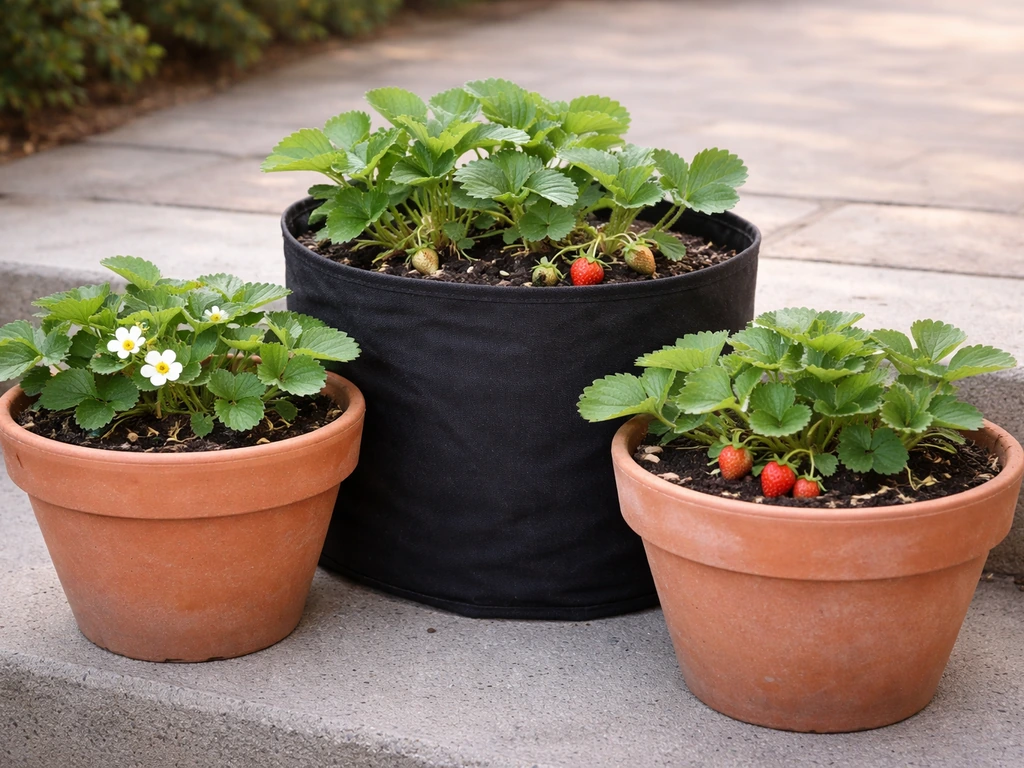
How to Grow Strawberries on a Patio: Container Guide
Step-by-step container guide to grow patio strawberries: varieties, pots, soil, watering, feeding, pests, overwintering,